Skip to content
+90 505 506 38 10 WhatsApp
← Back to the Academy
Real estate guide

Earthquake Risk, Insurance and Property Tax Guide

A risk-management guide covering earthquake exposure, property insurance and property-tax records while keeping technical, insurance and tax verification separate.

95 knowledge topics
Earthquake Risk, Insurance and Property Tax Guide

Earthquake, Insurance and Property-Tax Risk

This guide combines three separate review tracks that should not be collapsed into one conclusion: the building’s technical condition, insurance coverage and the property-tax record. Each track requires its own evidence and responsible reviewer.

Technical risk

Review available technical reports, building condition, strengthening works and open findings. If the technical result is not conclusive, record the need for specialist assessment rather than issuing an unsupported conclusion.

Insurance and tax

Check policy validity, insured-property details, coverage scope and dates, and separately trace tax liabilities, payments and records supporting the current status. Rules and figures that can change should be reconfirmed with the competent source at the transaction date.

Closing risk

Convert every finding into a clear action: missing document, technical assessment, payment evidence, insurance review or tax verification. Do not create a cost or legal conclusion without a source.

Keep the risk layers separate

Use the AFAD hazard map as regional context, not a building-specific structural safety certificate. Commission a qualified building review for structural questions. Compare insurance schedule, exclusions, deductible and coverage with the actual asset, then verify municipal tax obligations independently. Record distinct sources and dates for hazard, structure, insurance and tax rather than combining them into one unsupported rating.

JUANA Real Estate Editorial Team

Last reviewed: 2026-08-27

Content is reviewed against official and primary sources and updated when rules or information change.

Official review sources

Frequently Asked Questions

What is the difference between 2701, 2705 and 2709 in this guide?
2701 reconstructs the annual property-tax history; 2705 addresses tax risk in the resale decision; 2709 preserves the audit trail showing how the tax file reached its current state.

Topics in this guide

Property Taxes and Purchase Costs in Türkiye 2026

Property Taxes and Purchase Costs in Türkiye 2026

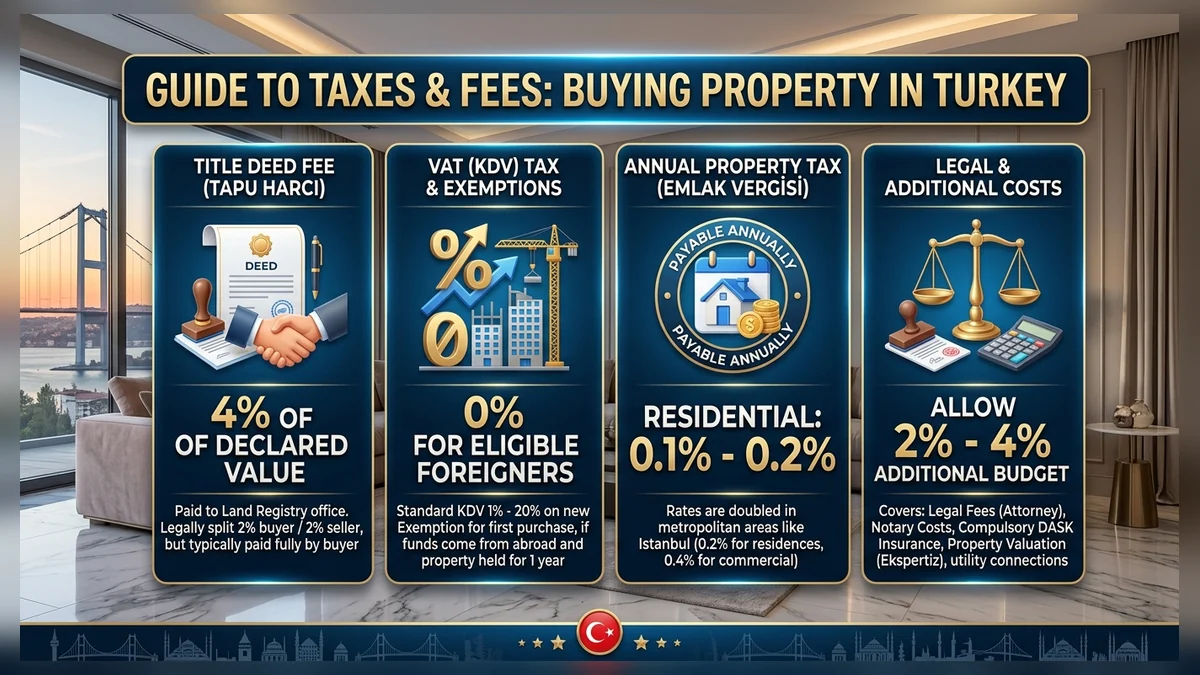
The amount paid for a property is only one part of the total acquisition and ownership budget in Türkiye. Some items are taxes or statutory fees, some are administrative service charges, and others are private costs such as legal review, translation or valuation. Treating all of them as one percentage is misleading because the legal basis, payer, timing and rate can differ.

Read topic →
Property Tax Debt Check Before Closing

Property Tax Debt Check Before Closing

Use Property Tax Debt Check Before Closing to build a clear, evidence-based answer to the topic itself. The guide separates verified facts from assumptions, records the competent source and date, and keeps any unresolved legal, technical, tax, payment or cost issue visible.

Read topic →
Municipal Property Tax Owner Checklist

Municipal Property Tax Owner Checklist

Municipal Property Tax Owner Checklist Core point Municipal property tax is tied to the tax value, taxpayer status and period, so review the municipality’s property record rather than estimating tax from market price alone. How to verify it After purchase check notification and liability timing with the competent municipality because title transfer does not eliminate administrative follow-up duties.

Read topic →
Title-Deed Fees, Property Taxes, Mortgages, Attachments and Aidat Due Diligence

Title-Deed Fees, Property Taxes, Mortgages, Attachments and Aidat Due Diligence

A 2026 verification guide to Turkish title-transfer charges: calculate title-deed fee from the genuine declared transfer value subject to the statutory property-tax-value floor, separate the title fee from TKGM service charges, use the current annual tariff and official payment channels, and preserve transaction-specific receipts.

Read topic →
Municipal property tax Verification Guide

Municipal property tax Verification Guide

A 2026 guide to Turkish municipal property-tax due diligence: identify the taxpayer, tax value, rate and instalments, check municipal arrears before transfer, and apply the special 2026 valuation rules introduced by Law 7566 and the Revenue Administration guidance.

Read topic →
Municipal Property Tax Workflow

Municipal Property Tax Workflow

Municipal property tax is a recurring legal financial obligation imposed by local administrations and municipalities on property owners. The workflow is intended to support the collection of revenue used for infrastructure, public maintenance, waste collection and local facilities. Understanding the process protects owners and buyers from accumulated penalties and legal consequences that could adversely affect the property.

Read topic →
Buyer Questions for Municipal property tax

Buyer Questions for Municipal property tax

Buyer Questions for Municipal property tax Ask the last tax year paid, whether any municipal debt remains, the current tax value, municipal classification/use, date of the last update, and whether any owner-specific exemption or reduced rate may cease after transfer. municipal property tax: TKGM states that the property-tax value determined under the Emlak Vergisi framework is transmitted to land-registry offices, and the declared sale value used for title fees may not be below that property-tax value.

Read topic →
Closing-Day Check for Municipal property tax

Closing-Day Check for Municipal property tax

Municipal property tax ( Emlak Vergisi ) is different from title-transfer charges and from any income tax that may arise for the seller. 1319, published by GİB, places buildings and land within a property-tax system based on tax values, while administration is handled through the relevant municipality. A closing file should therefore separate three figures: the property’s tax value, any accrued or overdue property tax, and other taxes or fees connected with the transfer.

Read topic →
DASK, Energy Performance (EKB), Building Insurance and Fire-Safety Due Diligence

DASK, Energy Performance (EKB), Building Insurance and Fire-Safety Due Diligence

A verification guide for DASK in Turkish property purchases: confirm the compulsory earthquake policy is active, reconcile address, area and construction data, understand coverage and exclusions, recheck it for title, utilities and financing, and never treat the policy as a structural-safety certificate.

Read topic →
DASK earthquake insurance Workflow Guide

DASK earthquake insurance Workflow Guide

DASK earthquake insurance Workflow Guide Workflow: confirm unit/address → query the policy on DASK → match insured/owner data, address code, gross area, construction type and building details → check start/end dates → correct any material mismatch before relying on the policy. Under DASK’s currently published tariff, from 1 August 2026 the maximum insured amount is TRY 2,451,062; the unit construction values are TRY 11,562 for reinforced-concrete buildings and TRY 7,708 for other construction types.

Read topic →
DASK earthquake insurance Decision Framework

DASK earthquake insurance Decision Framework

A decision framework separates “factually correct” from “fit for purpose.” After verification, measure the topic’s effect on price, usability, financing, risk and exit cost. The final note should explain why the outcome is accept, accept with conditions or walk away. In “DASK earthquake insurance Decision Framework”, apply this evidence through the decision framework and reconcile dask/insurance/decision/framework to the controlling record for the same property before accepting the conclusion.

Read topic →
Buyer Questions for DASK earthquake insurance

Buyer Questions for DASK earthquake insurance

DASK compulsory earthquake insurance: DASK lists building address, title information, construction year/type, storey count, damage status, dwelling gross area and use among policy inputs; the insured amount follows tariff rules and a maximum limit, so it is not the same as the property’s market value. Official source: DASK Required Information Under DASK’s currently published tariff, from 1 August 2026 the maximum insured amount is TRY 2,451,062; the unit construction values are TRY 11,562 for reinforced-concrete buildings and TRY 7,708 for other construction types.

Read topic →
Closing-Day Check for DASK earthquake insurance

Closing-Day Check for DASK earthquake insurance

keys, handover and condition record DASK — Tariff and Premiums — 15 August 2026 DASK — Coverage and Scope — 15 August 2026 DASK — Compulsory Earthquake Insurance Terms — 15 August 2026 Near closing, query again if expiry is close or property data changed. Record the final policy number and verification date, and do not rely on an emailed copy if the official query shows a different status. Under DASK’s currently published tariff, from 1 August 2026 the maximum insured amount is TRY 2,451,062; the unit construction values are TRY 11,562 for reinforced-concrete buildings and TRY 7,708 for other construction types.

Read topic →
DASK earthquake insurance Recordkeeping Guide

DASK earthquake insurance Recordkeeping Guide

The conclusion for “DASK earthquake insurance Recordkeeping Guide” should end in one of three states: verified/actionable, actionable subject to written dated conditions, or stop until the conflict is resolved. DASK — Tariff and Premiums — 15 August 2026 DASK — Coverage and Scope — 15 August 2026 DASK — Compulsory Earthquake Insurance Terms — 15 August 2026 Preserve the policy, query result, address code, area/building data, inception/expiry and issuance/renewal receipt.

Read topic →
DASK earthquake insurance Red Flags Guide

DASK earthquake insurance Red Flags Guide

refusal to provide document reference material promise absent from contract The conclusion for “DASK earthquake insurance Red Flags Guide” should end in one of three states: verified/actionable, actionable subject to written dated conditions, or stop until the conflict is resolved. DASK — Tariff and Premiums — 15 August 2026 DASK — Coverage and Scope — 15 August 2026 DASK — Compulsory Earthquake Insurance Terms — 15 August 2026 Under DASK’s currently published tariff, from 1 August 2026 the maximum insured amount is TRY 2,451,062; the unit construction values are TRY 11,562 for reinforced-concrete buildings and TRY 7,708 for other construction types.

Read topic →
Building Insurance Verification Guide Before Property Purchase

Building Insurance Verification Guide Before Property Purchase

A guide separating compulsory DASK from voluntary cover and verifying property/insured identity, policy period, insured amount, perils, exclusions, endorsements, finance conditions and evidence of issuance.

Read topic →
Building insurance Workflow Guide

Building insurance Workflow Guide

A practical guide to voluntary building/home insurance in Türkiye: distinguish it from DASK, define the insured property, value, perils, extensions, exclusions and deductibles, verify beneficiary/mortgage and claims history, and retain the policy, endorsements and renewal evidence.

Read topic →
Building insurance Risk Review

Building insurance Risk Review

For “Building insurance Risk Review”, the land-registry record must be separated from marketing descriptions. TKGM lists party identification and, where representation is used, the representation document among sale-transaction materials; the registered owner, independent-unit details and recorded restrictions remain the controlling evidence when descriptions conflict. Names, identity or passport data and property identifiers should therefore be reconciled before signature, and the registry output relied upon should be preserved with its retrieval date.

Read topic →
Building insurance Decision Framework

Building insurance Decision Framework

For “Building insurance Decision Framework”, authenticity is established through the issuing authority and chain of acquisition, not by the appearance of a PDF or an institutional logo. If bank-account or payment instructions change by email or message, the change should be confirmed through an independent, previously verified channel before funds move; a genuine contract does not make later payment instructions automatically genuine. Official systems such as EİDS or Web Tapu prove only the elements within their scope and should not be used to legitimize unrelated data.

Read topic →
Buyer Questions for Building insurance

Buyer Questions for Building insurance

Buyer Questions for Building insurance A buyer should ask whether the policy shown matches the exact unit/address and is current through the relevant handover/closing period. Check the insured party and policy number rather than accepting a generic building certificate. Ask separately what DASK covers and what additional policy covers: insured perils, building versus contents, liability, exclusions, limits and deductibles. Do not interpret “insured” as “all-risk.” For apartments, ask who insures common areas and major building systems, whether the management can provide current evidence, and what the buyer must arrange personally after transfer.

Read topic →
Building Insurance Closing-Day Check

Building Insurance Closing-Day Check

Final closing-day check for valid property-matched DASK, issued required additional cover, no inception gap, lender-condition match, coverage limits and retained evidence.

Read topic →
Building insurance Recordkeeping Guide

Building insurance Recordkeeping Guide

Keep the exact version used DASK’s coverage page identifies structural parts such as foundations, main and common walls, floors, stairs, elevators, corridors, roofs and similar complementary parts of the building. Good records prevent reuse of expired versions and allow the chronology to be proved on resale or dispute. DASK states that the policy term is one year and must be renewed annually, and that coverage responsibility ends at the policy expiry date if renewal does not occur.

Read topic →
Building insurance Red Flags Guide

Building insurance Red Flags Guide

refusal to provide document reference material promise absent from contract DASK — Coverage and Scope — 15 August 2026 DASK — Compulsory Earthquake Insurance Terms — 15 August 2026 TKGM — Tapu ve Kadastro Genel Müdürlüğü — 15 August 2026 First identify the insurance product. DASK is compulsory earthquake insurance with defined scope, limits and exclusions; having DASK does not mean contents, lost rent or every building risk is insured. DASK states that owners whose dwelling value exceeds the compulsory maximum can obtain optional additional coverage for the excess, while the general conditions exclude various indirect losses and contents.

Read topic →
Earthquake risk screening Verification Guide

Earthquake risk screening Verification Guide

A Turkish property earthquake-screening guide: use the AFAD hazard map as a hazard input, not a building-safety verdict; review soil, construction era, records, damage and alterations; and separate initial screening from engineering assessment or formal risky-building determination under Law 6306.

Read topic →
Earthquake risk screening Risk Review

Earthquake risk screening Risk Review

Start with AFAD site hazard and building age/system, and tie both to the exact property, party and transaction date. The evidence file should cover AFAD site hazard, building age/system, alterations, technical reports and Riskli Yapı records. A document can be genuine yet still be unusable if it belongs to a different unit, parcel, year or transaction. For the risk review, test the strongest claim first.

Read topic →
Earthquake risk screening Decision Framework

Earthquake risk screening Decision Framework

Start with AFAD site hazard and building age/system, and tie both to the exact property, party and transaction date. For the decision framework, test the strongest claim first. If alterations conflicts with technical reports, preserve both pieces of evidence and identify the reason for the conflict before treating the file as complete. Topic-specific application: AFAD’s Türkiye Earthquake Hazard Map has been in force since 1 January 2019 and expresses hazard by location coordinates; it is a hazard tool, not a certificate that a specific building is earthquake-resistant.

Read topic →
Buyer Questions for Earthquake risk screening

Buyer Questions for Earthquake risk screening

Treat this as a transaction decision file. For “Buyer Questions for Earthquake risk screening”, begin with earthquake and risk and make sure both relate to the same asset, party and review date. Cure the issue by re-pulling the competent official record, reconciling identifiers, comparing versions and documenting why the new evidence supersedes the old. Use PASS only when current evidence supports the transaction assumption.

Read topic →
Closing-Day Check for Earthquake risk screening

Closing-Day Check for Earthquake risk screening

Start from the fact that would change the deal if wrong. For “Closing-Day Check for Earthquake risk screening”, begin with earthquake and risk and make sure both relate to the same asset, party and review date. Mark each as verified, conflicting, stale or unavailable. Check screening independently from the person or document that supplied earthquake. If it conflicts with closing, identify the authoritative owner of the fact and obtain a fresh record.

Read topic →
Earthquake risk screening Recordkeeping Guide

Earthquake risk screening Recordkeeping Guide

Start with AFAD site hazard and building age/system, and tie both to the exact property, party and transaction date. For the recordkeeping, test the strongest claim first. If alterations conflicts with technical reports, preserve both pieces of evidence and identify the reason for the conflict before treating the file as complete. Example: the file contains AFAD site hazard, but Riskli Yapı records cannot be verified.

Read topic →
Earthquake risk screening Red Flags Guide

Earthquake risk screening Red Flags Guide

Start with AFAD site hazard and building age/system, and tie both to the exact property, party and transaction date. For red flags, test the strongest claim first. If alterations conflicts with technical reports, preserve both pieces of evidence and identify the reason for the conflict before treating the file as complete. Example: the file contains AFAD site hazard, but Riskli Yapı records cannot be verified.

Read topic →
Official Source Revalidation — Municipal property tax

Official Source Revalidation — Municipal property tax

Revalidating municipal property tax means checking the competent municipality’s property/taxpayer record rather than an old figure in a contract or listing.

Read topic →
Exception Register — Municipal property tax

Exception Register — Municipal property tax

An exception register for Turkish municipal property tax, separating discrepancies in tax value, taxpayer, property, year or payment and assigning an official source, owner and closure evidence to each issue.

Read topic →
Payment Release Gate — Municipal property tax

Payment Release Gate — Municipal property tax

A payment-release gate linking transaction funds to the agreed municipal property-tax condition, checking tax value, taxpayer, year and payment without claiming every municipal debt automatically blocks registration.

Read topic →
Change Control — Municipal property tax

Change Control — Municipal property tax

Change control for municipal property-tax files across tax years and the transaction, recording changes to owner, property, value, classification, law or payment and reopening dependent decisions.

Read topic →
Payment Release Gate — DASK earthquake insurance

Payment Release Gate — DASK earthquake insurance

A DASK-linked payment-release gate that prevents a conditioned payment from moving until a covered property has a correct, valid policy matched to the unit on the transaction date.

Read topic →
Counterparty Confirmation — Building insurance

Counterparty Confirmation — Building insurance

A decision-focused guide to Counterparty Confirmation — Building insurance: obtain independent confirmation of material facts from the responsible party or issuer instead of relying on a forwarded copy alone, preserve the controlling evidence, recheck material changes.

Read topic →
Payment Release Gate — Building insurance

Payment Release Gate — Building insurance

A building-insurance payment gate for a voluntary or contract-required policy, checking the insured property, covers, sum insured, exclusions, premium status, validity and any lender interest before release.

Read topic →
Official Source Revalidation — Earthquake risk screening

Official Source Revalidation — Earthquake risk screening

AFAD’s current hazard map took effect on 1 January 2019 and is a hazard map, not a building-risk certificate; it uses point-based ground-acceleration values rather than the old earthquake-zone grades. Revalidate site hazard through AFAD and official risky-building status/process through the Ministry.

Read topic →
Validity and Deadline Control — Earthquake risk screening

Validity and Deadline Control — Earthquake risk screening

earthquake risk screening: AFAD explicitly states that Türkiye’s Earthquake Hazard Map is a HAZARD map, not a building RISK map; assessing a specific building requires exposure/structural information and local conditions in addition to regional hazard. Record the effective, issue, expiry or renewal date relevant to this evidence and test whether it is still fit for the transaction date.

Read topic →
Payment Release Gate — Earthquake risk screening

Payment Release Gate — Earthquake risk screening

Revalidate site hazard through AFAD and official risky-building status/process through the Ministry. For the building itself, review age, structural system, alterations and engineering or Riskli Yapı records where relevant.

Read topic →
Earthquake Risk Screening Change Control

Earthquake Risk Screening Change Control

This record controls new information that can change an earthquake-risk screening outcome, such as a newer engineering report, updated building data or a fresh rapid-screening result. Compare the old and new result and document whether the change affects the purchase decision or triggers deeper engineering review. A hazard map alone is not a building-specific safety conclusion.

Read topic →
Property Tax and Government Fees Records Verification Guide

Property Tax and Government Fees Records Verification Guide

Verification of property-tax and government-fee records is a core due-diligence step. It helps the buyer compare the documents presented in the transaction with current official information and the actual condition of the property. The review should focus on authenticity, validity, scope, dates, responsible parties and any material inconsistency that could affect use, transfer, cost or future resale.

Read topic →
Property Tax and Government Fees Records Risk Review

Property Tax and Government Fees Records Risk Review

A risk review of property-tax and government-fee records is intended to identify weaknesses that may be hidden by apparently complete paperwork. The review considers whether the records are current, authentic, internally consistent and aligned with the actual property or service. It also asks whether missing or inaccurate information could create legal, financial, safety or operating costs for the buyer.

Read topic →
Property Tax and Government Fees Records Decision Framework

Property Tax and Government Fees Records Decision Framework

The decision framework for property-tax and government-fee records converts document review into a controlled transaction decision. It is designed to prevent a buyer from proceeding merely because a document exists; the document must also be current, relevant, consistent and sufficiently verified.

Read topic →
Property Tax and Government Fees Records Closing Day Check

Property Tax and Government Fees Records Closing Day Check

The closing-day check for property-tax and government-fee records is the final confirmation that the transaction is relying on the latest and correct records. It should verify that no material change has occurred between earlier due diligence and the transfer or final payment.

Read topic →
Independent Evidence Replication — Municipal property tax

Independent Evidence Replication — Municipal property tax

Use Independent Evidence Replication — Municipal property tax to organize the file so an independent reviewer can reproduce the same conclusion without relying on the original adviser’s assertion. The guide separates verified facts from assumptions, records the competent source and date, and keeps any unresolved legal, technical, tax, payment or cost issue visible.

Read topic →
Pre-Commitment Freeze — Municipal property tax

Pre-Commitment Freeze — Municipal property tax

Pre-Commitment Freeze — Municipal property tax explains how to freeze the material transaction facts and document versions before a deposit, reservation, signature or other commitment becomes difficult to reverse, how to match evidence to the same asset and decision date, and how to convert a discrepancy into a written condition rather than a vague assurance.

Read topic →
Document Version Reconciliation — Municipal property tax

Document Version Reconciliation — Municipal property tax

Document Version Reconciliation — Municipal property tax: a practical guide to identify the controlling version and reconcile every material change between drafts, scans, translations and signed documents, with emphasis on current evidence, property and party identity, document version, unresolved conflicts and the transaction consequence before commitment.

Read topic →
Cost Consequence Trace — Municipal property tax

Cost Consequence Trace — Municipal property tax

A decision-focused guide to Cost Consequence Trace — Municipal property tax: trace each issue to a documented cost, responsible payer, timing and effect on price, cash flow or closing funds, preserve the controlling evidence, recheck material changes.

Read topic →
Resale and Exit Review — Municipal property tax

Resale and Exit Review — Municipal property tax

Use the current municipality record for the same property, including the relevant tax year/value and any available debt or payment status. An old value in the purchase file should not be assumed to describe the resale-year position.

Read topic →
Cross-Party Consistency Check — Municipal property tax

Cross-Party Consistency Check — Municipal property tax

A value or receipt from another year may not represent the current transfer-year position. Record the year explicitly and obtain the municipality record applicable to the transaction period.

Read topic →
Closing-Day Recheck — Municipal property tax

Closing-Day Recheck — Municipal property tax

Closing-Day Recheck — Municipal property tax explains how to repeat the critical checks immediately before completion so stale evidence is not mistaken for current status, how to match evidence to the same asset and decision date, and how to convert a discrepancy into a written condition rather than a vague assurance.

Read topic →
Insurance Records and Coverage Verification Guide

Insurance Records and Coverage Verification Guide

Verification of insurance records and property coverage is a core due-diligence step. It helps the buyer compare the documents presented in the transaction with current official information and the actual condition of the property. The review should focus on authenticity, validity, scope, dates, responsible parties and any material inconsistency that could affect use, transfer, cost or future resale.

Read topic →
Independent Evidence Replication — DASK earthquake insurance

Independent Evidence Replication — DASK earthquake insurance

Independent re-verification of a DASK policy through official data, matching policy number, address, floor area, construction type and validity to the actual dwelling.

Read topic →
Pre-Commitment Freeze — DASK earthquake insurance

Pre-Commitment Freeze — DASK earthquake insurance

A dated pre-commitment snapshot of the DASK policy, inquiry, dwelling data and tariff context, preserving later renewals or corrections as separate changes.

Read topic →
Insurance Records and Coverage Risk Review

Insurance Records and Coverage Risk Review

A risk review of insurance records and property coverage is intended to identify weaknesses that may be hidden by apparently complete paperwork. The review considers whether the records are current, authentic, internally consistent and aligned with the actual property or service. It also asks whether missing or inaccurate information could create legal, financial, safety or operating costs for the buyer.

Read topic →
Insurance Records and Coverage Closing Day Check

Insurance Records and Coverage Closing Day Check

The closing-day check for insurance records and property coverage is the final confirmation that the transaction is relying on the latest and correct records. It should verify that no material change has occurred between earlier due diligence and the transfer or final payment.

Read topic →
Insurance Records and Coverage Recordkeeping

Insurance Records and Coverage Recordkeeping

A structured archive for insurance records and property coverage allows the owner or reviewer to reconstruct what was checked, which document version was relied upon and how exceptions were resolved. Good recordkeeping supports later management, audit and resale.

Read topic →
Resale and Exit Review — DASK earthquake insurance

Resale and Exit Review — DASK earthquake insurance

Prepares the DASK record for resale by making the current policy, renewals and corrections understandable to the next buyer without treating the insured amount as a property valuation.

Read topic →
Insurance Records and Coverage Red Flags

Insurance Records and Coverage Red Flags

Red flags in insurance records and property coverage are warning signs that the file may be incomplete, inaccurate, outdated or inconsistent with the actual property or transaction. A red flag does not automatically prove a defect, but it requires documented follow-up before the buyer relies on the record.

Read topic →
Closing-Day Recheck — DASK earthquake insurance

Closing-Day Recheck — DASK earthquake insurance

A closing-day DASK review confirming that the policy relied on at transfer is still valid and property-specific, with any renewal or late correction reconciled before reliance.

Read topic →
Independent Evidence Replication — Building insurance

Independent Evidence Replication — Building insurance

Shows how to independently verify a building policy through the insurer and SEDDK conditions, matching the property and reading coverage, exclusions and endorsements without confusing it with DASK or structural inspection.

Read topic →
Pre-Commitment Freeze — Building insurance

Pre-Commitment Freeze — Building insurance

Creates a dated pre-commitment baseline of the building policy, endorsements, limits and exclusions so later insurance changes can be assessed against the terms the buyer actually relied on.

Read topic →
Document Version Reconciliation — Building insurance

Document Version Reconciliation — Building insurance

How to reconcile a building-insurance policy, endorsements and renewals so the buyer identifies the operative coverage, amounts and risk changes rather than relying on the newest-looking document.

Read topic →
Cost Consequence Trace — Building insurance

Cost Consequence Trace — Building insurance

A building-insurance cost review that separates premium from deductibles, underinsurance, valuation method, missing perils and payment timing to show the buyer’s true retained risk.

Read topic →
Resale and Exit Review — Building insurance

Resale and Exit Review — Building insurance

A resale-focused review of building insurance covering change of interest holder, insurer notification, post-transfer risk changes, insurance value and the buyer’s confirmed policy position.

Read topic →
Cross-Party Consistency Check — Building insurance

Cross-Party Consistency Check — Building insurance

Use Cross-Party Consistency Check — Building insurance to compare the same names, property identifiers, amounts, dates and obligations across every relevant party and document. The guide separates verified facts from assumptions, records the competent source and date, and keeps any unresolved legal, technical, tax, payment or cost issue visible.

Read topic →
Closing-Day Recheck — Building insurance

Closing-Day Recheck — Building insurance

Closing-day building-insurance verification focused on live policy dates, premium payment, property identity, coverage, limits and the ownership-change steps required immediately after transfer.

Read topic →
Pre-Commitment Freeze — Earthquake risk screening

Pre-Commitment Freeze — Earthquake risk screening

Pre-Commitment Freeze — Earthquake risk screening: AFAD’s Turkey Earthquake Hazard Map is a hazard map, not a building-specific risk map; it does not by itself combine building vulnerability, exposure and expected losses. The record focuses on Pre-Commitment Freeze within Earthquake risk screening.

Read topic →
Closing-Day Recheck — Earthquake risk screening

Closing-Day Recheck — Earthquake risk screening

Closing-Day Recheck — Earthquake risk screening: a practical guide to repeat the critical checks immediately before completion so stale evidence is not mistaken for current status, with emphasis on current evidence, property and party identity, document version, unresolved conflicts and the transaction consequence before commitment.

Read topic →
Insurance and Risk Management Records Verification Guide

Insurance and Risk Management Records Verification Guide

Verification of insurance and risk-management records is a core due-diligence step. It helps the buyer compare the documents presented in the transaction with current official information and the actual condition of the property. The review should focus on authenticity, validity, scope, dates, responsible parties and any material inconsistency that could affect use, transfer, cost or future resale.

Read topic →
Insurance and Risk Management Records Risk Review

Insurance and Risk Management Records Risk Review

A risk review of insurance and risk-management records is intended to identify weaknesses that may be hidden by apparently complete paperwork. The review considers whether the records are current, authentic, internally consistent and aligned with the actual property or service. It also asks whether missing or inaccurate information could create legal, financial, safety or operating costs for the buyer.

Read topic →
Insurance and Risk Management Records Decision Framework

Insurance and Risk Management Records Decision Framework

The decision framework for insurance and risk-management records converts document review into a controlled transaction decision. It is designed to prevent a buyer from proceeding merely because a document exists; the document must also be current, relevant, consistent and sufficiently verified.

Read topic →
Insurance and Risk Management Records Recordkeeping

Insurance and Risk Management Records Recordkeeping

A structured archive for insurance and risk-management records allows the owner or reviewer to reconstruct what was checked, which document version was relied upon and how exceptions were resolved. Good recordkeeping supports later management, audit and resale.

Read topic →
Insurance and Risk Management Records Red Flags

Insurance and Risk Management Records Red Flags

Red flags in insurance and risk-management records are warning signs that the file may be incomplete, inaccurate, outdated or inconsistent with the actual property or transaction. A red flag does not automatically prove a defect, but it requires documented follow-up before the buyer relies on the record.

Read topic →
Source Freshness Review — Municipal property tax

Source Freshness Review — Municipal property tax

Source Freshness Review — Municipal property tax: Emlak Vergisi is an annual municipal property tax on buildings and land in Türkiye, payable to the municipality where the property is registered. The record focuses on Source Freshness Review within Municipal property tax.

Read topic →
Deadline Readiness Review — Municipal property tax

Deadline Readiness Review — Municipal property tax

Deadline Readiness Review — Municipal property tax: Emlak Vergisi is an annual municipal property tax on buildings and land in Türkiye, payable to the municipality where the property is registered. The record focuses on Deadline Readiness Review within Municipal property tax.

Read topic →
Audit Trail Reconstruction — Municipal property tax

Audit Trail Reconstruction — Municipal property tax

Audit Trail Reconstruction — Municipal property tax: Emlak Vergisi is an annual municipal property tax on buildings and land in Türkiye, payable to the municipality where the property is registered. The record focuses on Audit Trail Reconstruction within Municipal property tax.

Read topic →
Source Freshness Review — DASK earthquake insurance

Source Freshness Review — DASK earthquake insurance

A decision-focused guide to Source Freshness Review — DASK earthquake insurance: confirm that the relied-on rule, registry extract, certificate or other evidence is current enough for the decision date, preserve the controlling evidence, recheck material changes.

Read topic →
Source Freshness Review — Building insurance

Source Freshness Review — Building insurance

Use Source Freshness Review — Building insurance to confirm that the relied-on rule, registry extract, certificate or other evidence is current enough for the decision date. The guide separates verified facts from assumptions, records the competent source and date, and keeps any unresolved legal, technical, tax, payment or cost issue visible.

Read topic →
Deadline Readiness Review — Building insurance

Deadline Readiness Review — Building insurance

Deadline Readiness Review — Building insurance explains how to confirm that required documents, approvals and responsible parties will be ready before the relevant contractual or filing deadline, how to match evidence to the same asset and decision date, and how to convert a discrepancy into a written condition rather than a vague assurance.

Read topic →
Audit Trail Reconstruction — Building insurance

Audit Trail Reconstruction — Building insurance

Audit Trail Reconstruction — Building insurance: SEDDK publishes separate general conditions for fire insurance and for compulsory earthquake insurance, so a building policy should not be assumed to be DASK or to cover the same risks. The record focuses on Audit Trail Reconstruction within Building insurance.

Read topic →
Source Freshness Review — Earthquake risk screening

Source Freshness Review — Earthquake risk screening

A decision-focused guide to Source Freshness Review — Earthquake risk screening: confirm that the relied-on rule, registry extract, certificate or other evidence is current enough for the decision date, preserve the controlling evidence, recheck material changes.

Read topic →
Insurance and Property Warranties Records Verification Guide

Insurance and Property Warranties Records Verification Guide

Verification of insurance and property-warranty records is a core due-diligence step. It helps the buyer compare the documents presented in the transaction with current official information and the actual condition of the property. The review should focus on authenticity, validity, scope, dates, responsible parties and any material inconsistency that could affect use, transfer, cost or future resale.

Read topic →
Insurance and Property Warranties Records Risk Review

Insurance and Property Warranties Records Risk Review

A risk review of insurance and property-warranty records is intended to identify weaknesses that may be hidden by apparently complete paperwork. The review considers whether the records are current, authentic, internally consistent and aligned with the actual property or service. It also asks whether missing or inaccurate information could create legal, financial, safety or operating costs for the buyer.

Read topic →
Insurance and Property Warranties Records Decision Framework

Insurance and Property Warranties Records Decision Framework

The decision framework for insurance and property-warranty records converts document review into a controlled transaction decision. It is designed to prevent a buyer from proceeding merely because a document exists; the document must also be current, relevant, consistent and sufficiently verified.

Read topic →
Insurance and Property Warranties Records Closing Day Check

Insurance and Property Warranties Records Closing Day Check

At closing, insurance and property-warranty records should be tested for continuity of real coverage. Verify the insured party, property, limits, deductibles, exclusions, expiry and open claims. Warranties should be reviewed separately because the responsible provider and claim conditions differ fro

Read topic →
Insurance and Property Warranties Records Recordkeeping

Insurance and Property Warranties Records Recordkeeping

A structured archive for insurance and property-warranty records allows the owner or reviewer to reconstruct what was checked, which document version was relied upon and how exceptions were resolved. Good recordkeeping supports later management, audit and resale.

Read topic →
Insurance and Property Warranties Records Red Flags

Insurance and Property Warranties Records Red Flags

Red flags in insurance and property-warranty records are warning signs that the file may be incomplete, inaccurate, outdated or inconsistent with the actual property or transaction. A red flag does not automatically prove a defect, but it requires documented follow-up before the buyer relies on the record.

Read topic →
Property Tax and Municipal Fees Records Verification Guide

Property Tax and Municipal Fees Records Verification Guide

Verification of real-estate tax and fee records is a core due-diligence step. It helps the buyer compare the documents presented in the transaction with current official information and the actual condition of the property. The review should focus on authenticity, validity, scope, dates, responsible parties and any material inconsistency that could affect use, transfer, cost or future resale.

Read topic →
Property Tax and Municipal Fees Records Risk Review

Property Tax and Municipal Fees Records Risk Review

A risk review of real-estate tax and fee records is intended to identify weaknesses that may be hidden by apparently complete paperwork. The review considers whether the records are current, authentic, internally consistent and aligned with the actual property or service. It also asks whether missing or inaccurate information could create legal, financial, safety or operating costs for the buyer.

Read topic →
Property Tax and Municipal Fees Records Decision Framework

Property Tax and Municipal Fees Records Decision Framework

The decision framework for real-estate tax and fee records converts document review into a controlled transaction decision. It is designed to prevent a buyer from proceeding merely because a document exists; the document must also be current, relevant, consistent and sufficiently verified.

Read topic →
Property Tax and Municipal Fees Records Closing Day Check

Property Tax and Municipal Fees Records Closing Day Check

Closing the property-tax and municipal-fee file requires evidence of status through the transfer date, not an old receipt. Review taxable years, payments, penalties, valuation differences and the municipal assessed value used for the transaction. Property-specific municipal charges tied to services

Read topic →
Property Tax and Municipal Fees Records Recordkeeping

Property Tax and Municipal Fees Records Recordkeeping

A structured archive for real-estate tax and fee records allows the owner or reviewer to reconstruct what was checked, which document version was relied upon and how exceptions were resolved. Good recordkeeping supports later management, audit and resale.

Read topic →
Property Tax and Municipal Fees Records Red Flags

Property Tax and Municipal Fees Records Red Flags

Red flags in real-estate tax and fee records are warning signs that the file may be incomplete, inaccurate, outdated or inconsistent with the actual property or transaction. A red flag does not automatically prove a defect, but it requires documented follow-up before the buyer relies on the record.

Read topic →
JUANA Intelligent Site AgentKnows JUANA public sections, pages and content
Would you like an advisor to contact you?
The agent searches public site content only. Chat and browsing data may be stored to improve service and connect your request with the sales team. Private admin/client data is never exposed.