
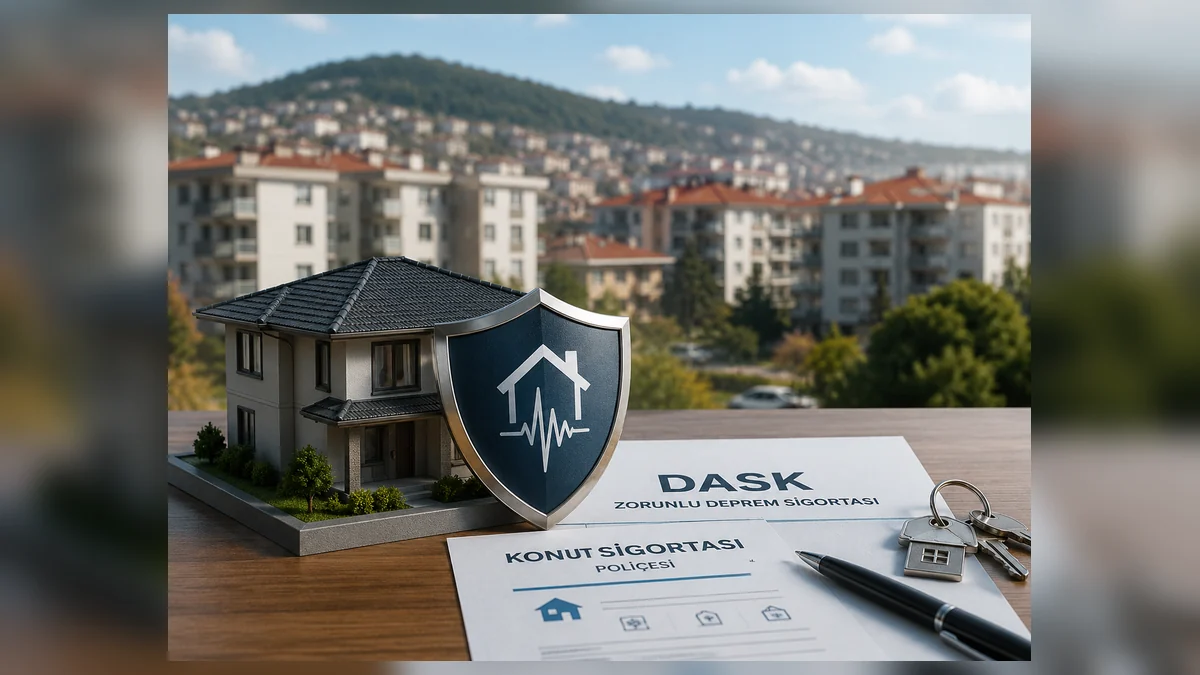
How to verify building insurance: start with the risk that must be covered, not the product label
A property purchase in Türkiye can involve more than one insurance layer. DASK is compulsory earthquake insurance for buildings within its legal scope, while voluntary fire or home insurance can cover other perils under its terms and endorsements. DASK does not prove that broad home insurance exists, and a voluntary home policy does not automatically satisfy the DASK requirement. Verify each policy for its own legal and contractual purpose.
1. Define what the transaction requires
Create separate lines for compulsory DASK where applicable, insurance required by the lender, and any protection required by the sale contract or selected by the buyer. Do not let the statement “the property is insured” replace the exact product and requirement.
2. Prove that a policy was actually issued
A quotation, application or payment to an intermediary is not an in-force policy. Obtain policy number, insurer, issue date, inception and expiry dates, and evidence of in-force status or an official query where available.
3. Match the insured property
Check address, address code where relevant, independent-unit details, use type, building area and key descriptors. A typographical error may be curable, but a different unit, address or use can mean the insured risk is not the property being purchased.
4. Match the insured interest
Identify the insured and policyholder and determine whether a bank or lender must be noted or otherwise protected under financing terms. Under DASK rules a tenant can arrange the policy while the owner is identified as the insured, so do not infer ownership merely from the person who paid the premium.
5. Read perils and clauses, not the marketing title
DASK has defined earthquake-related building coverage. Voluntary cover may use fire-insurance general conditions and add flood, internal water, storm or other risks through clauses. Confirm included risks, optional endorsements and exclusions rather than assuming a “home package” covers everything.
6. Check insured amounts and limits
Do not assume the policy amount equals purchase price. DASK follows its own insured-value rules; voluntary policies require review of building-value basis and separate limits for contents, liability, rent loss or other sections. Read deductibles and co-insurance where applicable.
7. Review pre-existing damage and claims
Ask about known prior damage and claims and any special exclusion or condition. The existence of a current policy does not turn pre-existing damage into an insured event.
8. Verify premium and policy status
Confirm the policy is not cancelled or suspended and that any activation or premium conditions are satisfied. Retain a verifiable full copy rather than a cropped image.
9. Keep engineering due diligence separate
Insurance transfers defined financial risk; it does not certify foundations, permit compliance or absence of prior defects. Structural and legal building checks remain separate.
Verification result
- Verified: required product is identified, policy issued/in force, property and parties match, and coverage is understood.
- Conditional: policy exists but a data correction, endorsement or inception-date change is required before closing.
- Not verified: only a quote exists, the policy relates to another property, or the cover does not meet the specified requirement.
DASK states that policy information includes the address code and title information, building year/type/floor count/damage status, and the dwelling’s gross area and use.
Required work
Independent verification
Build the conclusion from at least two independent records rather than one oral statement.
AFAD’s official earthquake hazard map describes spatial seismic hazard; it is not a safety report for a specific building. A property decision also needs building age, structural system, ground conditions, records and, when appropriate, technical inspection.
The DASK tariff published on 31 December 2025 sets the maximum compulsory cover for a dwelling at TRY 2,451,062, with amounts adjusted under the stated mechanism. Check the policy amount and date rather than reuse an old figure.
Compulsory cover and supplementary cover are not the same
DASK compulsory earthquake insurance covers defined earthquake-related building losses within the policy limits, while household contents and other risks may require separate voluntary cover. A building-insurance review should therefore read the policy period, property address, structural information and insured limit rather than assuming that the existence of a DASK policy means every building or contents loss is insured.
DASK’s coverage page identifies structural parts such as foundations, main and common walls, floors, stairs, elevators, corridors, roofs and similar complementary parts of the building. For the building insurance issue, use this evidence at the point of marking the subject as verified; do not substitute a generic document from another transaction.
Evidence and decision plan for Building insurance Verification Guide
“Building insurance Verification Guide” should be handled as a decision file, not as a collection of documents. Its working objective is to verify the claimed fact from the strongest available primary evidence before relying on it. Evidence is useful only when it can be tied to the same property, party and decision date.
Evidence to assemble
- For “Building insurance Verification Guide”, match the property and party identifiers in the evidence to the asset and people actually involved; a correct document for the wrong unit or person does not close the check.
- For “Building insurance Verification Guide”, record issuer, source, issue or retrieval date and version where available, then distinguish an original/current record from a scan, translation, draft, expired copy or superseded version.
- For “Building insurance Verification Guide”, compare documentary status with the physical, payment or operational reality relevant to the topic and write down every unexplained difference before commitment.
- For “Building insurance Verification Guide”, convert each unresolved difference into a named condition: evidence required, person responsible, deadline and the consequence if the condition is not satisfied.
Official reference to recheck
The source register for “Building insurance Verification Guide” includes TKGM — Tapu ve Kadastro Genel Müdürlüğü (https://www.tkgm.gov.tr/anasayfa). Use that source for the matters within its authority and recheck it when timing or rules are material; it does not replace a registry, engineering, tax, banking or contractual record that the specific decision separately requires.
Decision boundary
The decision for “Building insurance Verification Guide” is not “document present / document absent.” It is whether the evidence is current, identifies the right asset and parties, resolves material conflicts and supports the next irreversible step.
Practical closure test for Building insurance Verification Guide
Before relying on “Building insurance Verification Guide”, make the file answer the topic-specific objective in operational terms: verify the claimed fact from the strongest available primary evidence before relying on it. The evidence should identify the exact asset or transaction, show when the fact was checked, and distinguish a current verified fact from an assumption carried forward from an earlier stage.
For “Building insurance Verification Guide”, use TKGM — Tapu ve Kadastro Genel Müdürlüğü (https://www.tkgm.gov.tr/anasayfa) as one of the reference points already attached to the record. Confirm the scope of that source and keep any complementary registry, contract, engineering, tax, insurance or payment evidence separate so that one document is not asked to prove a fact outside its function.
A useful closure note for “Building insurance Verification Guide” should state what changed during the review, what remained unchanged, which discrepancy was resolved, and which residual issue—if any—was consciously accepted. If later resale, financing or dispute review would require the same evidence, preserve the controlling version and its retrieval date rather than only a narrative conclusion.