
Municipal property-tax due diligence in Türkiye
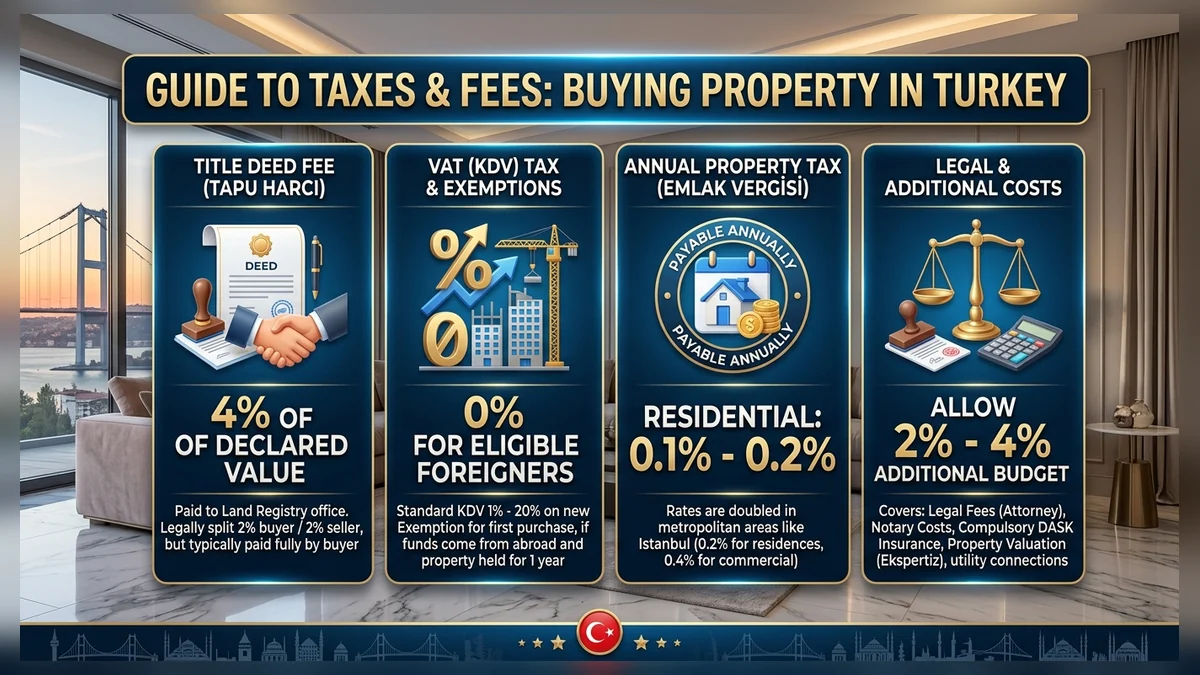
Emlak Vergisi is an annual municipal tax administered by the municipality where the property is located. It is not the title-transfer fee charged on a sale. A buyer should review it for two separate reasons: the official property-tax value also matters as a statutory floor in the title-fee process, and outstanding municipal tax can affect the ability to close cleanly. An old receipt or a seller statement is not a substitute for a current municipal record.
1. Identify the taxpayer
The Revenue Administration explains that the taxpayer is the owner; where a usufruct exists, the usufructuary is the taxpayer, and in the absence of both, the person possessing the property as owner can fall within the statutory rule. In shared ownership the obligation follows the ownership share, while joint ownership is treated under the relevant joint-liability rule. The due-diligence file should therefore reconcile title ownership, shares and usufruct rights rather than merely recording the name of the person who historically paid a bill.
2. Understand the tax value
The tax value is not a market valuation. For plots and land it is derived from minimum square-metre unit values fixed through the statutory valuation process by location and land classification. For buildings, the normal construction cost per square metre announced jointly by the competent ministries is used together with the land or land-share value under the statutory calculation. A tax value can therefore differ materially from the commercial sale price, but it remains an important official number for annual tax and for the minimum value used in certain fee calculations.
3. Rates and metropolitan doubling
The current Revenue Administration page states basic rates of 0.1% for residences, 0.2% for other buildings, 0.1% for land and 0.3% for building plots. Within metropolitan municipality boundaries those rates are doubled. For a residential property in Istanbul, for example, the ordinary building-tax rate is therefore 0.2%; other buildings are 0.4%, land 0.2% and building plots 0.6%. Classification matters: a residence rate should not be copied to commercial premises or land without checking the official status.
4. Instalment calendar
GİB states that the tax is paid in two instalments: the first during March, April and May and the second during November. Payment is made to the municipality where the property is registered for tax. In a purchase, obtain the current-year account and arrears position before closing, and decide contractually how amounts falling around the handover date are allocated. A private allocation between buyer and seller does not erase the municipality’s official account history.
5. Why 2026 requires special attention
Law No. 7566 introduced important changes in December 2025. Revenue Administration General Communiqué No. 89 explains the application of Temporary Article 23 of the Property Tax Law to minimum land values assessed in 2025 for 2026. The statutory Turkish wording caps 2026 building and land tax values relative to the 2025 value using the formula in Temporary Article 23 and also sets rules for new taxpayer situations. Because that formula can be misunderstood when paraphrased, a live file should use the municipality’s calculated value and the Communiqué rather than a simplified online multiplier.
6. Revaluation methodology also changed
Law 7566 amended Article 29 by replacing references to one-half of the revaluation rate with the revaluation rate itself for the relevant annual calculation, effective 19 December 2025. Older articles that still describe a permanent “half of revaluation” rule are therefore outdated. For future years, verify the legislation and the new annual guidance rather than freezing a past percentage into the property record.
7. Arrears and transfer
The Revenue Administration notes that, as a rule, a property cannot be transferred before due property tax has been paid, subject to statutory exceptions such as specified inheritance, court judgment, compulsory execution, expropriation and special-law cases. A land-registry appointment should therefore not be treated as proof that the municipal tax file is clean. If arrears appear, obtain a year-by-year breakdown, determine principal and additions, and preserve official evidence of payment or resolution before releasing the final price.
8. Buyer’s verification file
Obtain from the municipality or official channel the property identification, current tax value, arrears statement, recent payments and classification. Reconcile area, share and address with the title record. If there has been a recent acquisition, new building, use change, subdivision or merger, check whether the event created a new tax-liability or valuation consequence. A generic electronic receipt in the seller’s name is weak evidence if it cannot be tied to the exact independent unit.
9. Red flags
- A prior-year tax value reused for a 2026 closing without confirmation.
- Annual municipal tax being described as the title-transfer fee.
- A receipt that cannot be linked to the property.
- Old arrears with no year-by-year municipal statement.
- A residential rate applied to commercially classified property or land.
- An article still applying the pre-7566 half-revaluation rule.
- A manual calculation contradicting the municipal record with no reconciliation.
10. Records to keep
Retain the current-year tax value, municipal debt statement, payment receipts, classification, any notice that changed the liability and the value used in the title-transfer calculation. Record the date each item was obtained. A continuous tax record makes a later sale, valuation or audit materially easier than recreating the history from scattered receipts.
Frequently asked questions
Is property tax the same as the title fee? No. Emlak Vergisi is an annual municipal tax; the title fee arises from the transfer transaction.
When is it paid? GİB states that the first instalment is paid in March-May and the second in November.
Did the rules change for 2026? Yes. Law 7566 and Communiqué 89 introduced special 2026 valuation rules and changed the annual revaluation methodology.