
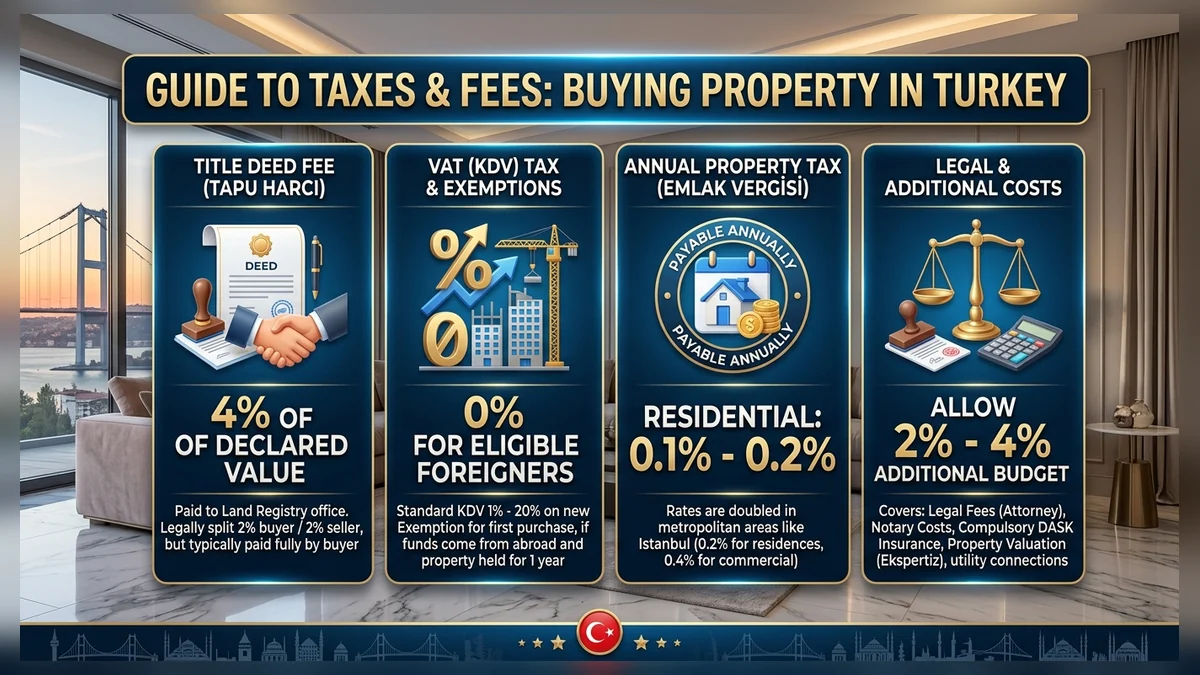
Why buyers should separate taxes from transaction costs
The amount paid for a property is only one part of the total acquisition and ownership budget in Türkiye. Some items are taxes or statutory fees, some are administrative service charges, and others are private costs such as legal review, translation or valuation. Treating all of them as one percentage is misleading because the legal basis, payer, timing and rate can differ.
This guide uses official Turkish sources reviewed in August 2026. Tax rules, exemptions, annual thresholds and administrative tariffs can change. Before signing or filing a return, verify the current position with the Revenue Administration (GİB), TKGM, the relevant municipality and a qualified tax adviser where appropriate.
1. Title-deed fee: the statutory transfer charge
For a normal sale for consideration, official GİB material applying the Fees Law states that the title-deed fee is assessed separately on the transferor and transferee at 20 per thousand — 2% each — based on the declared transfer/acquisition value, provided that value is not below the property-tax value used for the transaction. In practical terms, the statutory assessment and any private commercial agreement about who economically bears a cost are not the same question.
Do not understate the transaction value to reduce fees. The declared value must comply with the legal basis, and inconsistencies between contract price, bank transfers, foreign-exchange documentation and deed value can create legal and tax risk.
2. TKGM revolving-fund service charge is separate
The title-deed transaction may also involve a TKGM revolving-fund service charge. This is not the same as the title-deed fee. TKGM publishes an annual tariff; the 2026 tariff took effect from 1 January 2026. Because the applicable amount can depend on the tariff and transaction parameters, use the current TKGM schedule instead of copying a fixed number from an old article.
3. Annual property tax after acquisition
Property ownership can give rise to recurring municipal property-tax obligations. The amount depends on the legal classification, taxable value and applicable local rules, and special situations or exemptions can affect the result. For a new owner, the practical task is to identify the competent municipality, confirm the property record and understand when declarations or payments are required.
Do not confuse annual property tax with the one-time title transfer fee. They arise at different stages and are administered through different legal mechanisms.
4. VAT is transaction-specific, not a universal buyer percentage
Value added tax can be relevant in some real-estate transactions, particularly depending on the seller’s status, the nature of the supply, the property and any applicable exemption. A resale between individuals should not be assumed to have the same VAT treatment as a developer sale. Foreign-buyer or export-style exemptions can also have detailed conditions.
For this reason, does not publish a single universal VAT rate as if it applied to every purchase. Ask for the invoice/tax structure of the exact property and verify it against current GİB rules before calculating the total budget.
5. Valuation, DASK, translation and legal services are costs, not all taxes
A transaction may require or reasonably include valuation, compulsory earthquake insurance (DASK) for buildings, sworn translation, notarization or power-of-attorney costs, legal due diligence and banking charges. Citizenship-purpose transactions have additional valuation and banking-document requirements. These amounts should be listed as separate budget lines so the buyer knows which are statutory, which are service charges and which depend on the professional engaged.
6. Rental income creates a separate tax question
Owning a property and earning rent from it are different tax events. Rental income can be subject to Turkish income-tax reporting rules, annual exemptions or thresholds and rules governing deductible expenses. Those details can change from year to year. Keep contracts, bank receipts, management expenses and other supporting documents, and review the current GİB rental-income guidance for the relevant tax year.
A gross rental yield shown on a real-estate page is not the same as after-tax net return. Investors should model vacancy, building dues, management, repairs, insurance and applicable tax before comparing properties.
7. Selling later may have income-tax consequences
GİB publishes current guidance on value-increase gains from disposal of real estate, including the regime relevant to properties disposed of within five years in cases covered by the rules. The actual result depends on facts such as acquisition method, dates, documented cost basis, exemptions and the taxpayer’s situation. Do not use a simple “five-year rule” as a substitute for a tax calculation.
Retain the acquisition deed, official costs and documentary evidence of qualifying improvements. Good records at purchase can materially improve the accuracy of a later tax assessment.
8. Citizenship investment and tax are different tests
A property may satisfy a citizenship investment threshold only if the citizenship rules are met, but that does not remove ordinary transaction taxes, fees or other obligations. Likewise, paying the normal purchase charges does not prove citizenship eligibility. Keep the citizenship, title-deed and tax analyses separate and make sure the same official transaction values and banking evidence remain internally consistent.
9. Build a transparent acquisition-cost sheet
Before paying a deposit, prepare a written cost sheet with separate rows for: agreed property price; title-deed fee; TKGM service tariff; valuation if required; DASK/insurance; translation/notary/power of attorney; legal review; banking costs; project or management charges; and any transaction-specific VAT or tax confirmed for the property. Mark each amount as confirmed, estimated or not yet applicable.
10. Questions to ask before closing
- What is the lawful declared transfer value and does it match the transaction evidence?
- Who is legally assessed the title-deed fee and what has been agreed commercially between the parties?
- What is the current TKGM service tariff for this transaction?
- Is VAT applicable to this seller/property, and is any exemption actually documented?
- What municipal property-tax obligations start after acquisition?
- If the unit will be rented, what is the current tax-year reporting position?
- If resale is part of the plan, what records should be retained for a future gain calculation?
Tax information changes. This guide is educational and should be verified against current GİB/TKGM/municipal guidance and professional advice for the exact transaction.