
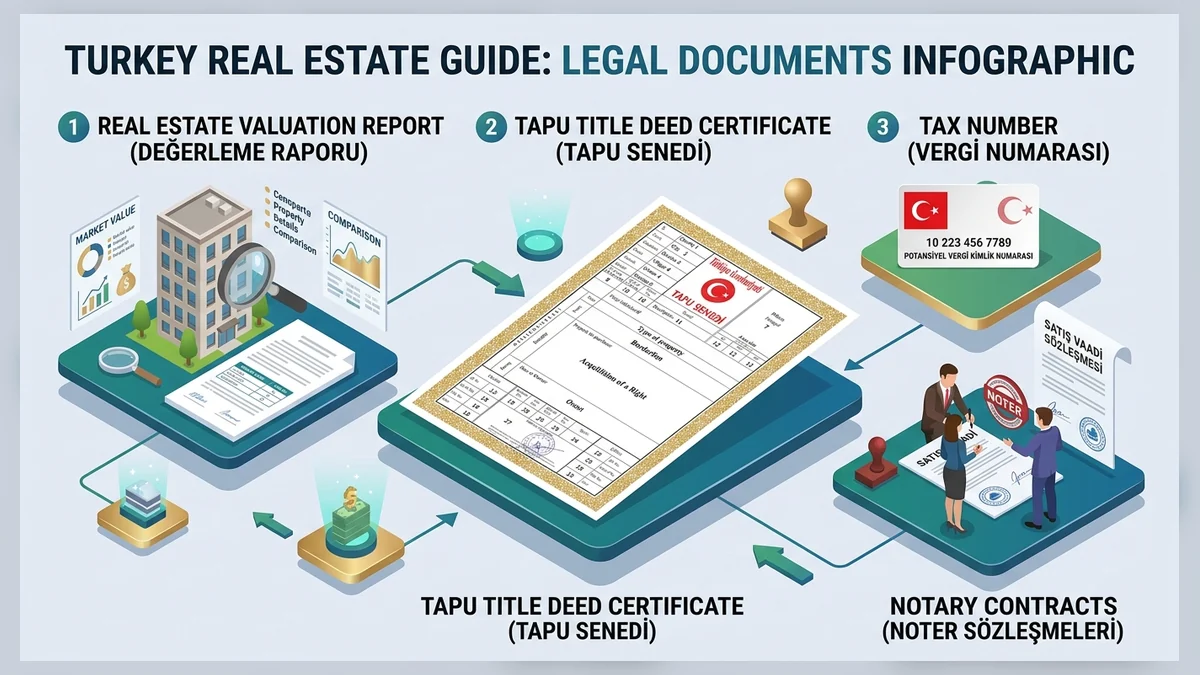
Turkish title deed and land registry: how to read the record before relying on it
The Turkish word tapu is commonly used for the title deed and, more broadly, for land-registry information. For a buyer, the essential legal distinction is between evidence about a transaction and the registered property right itself. A reservation form, sales invoice, bank receipt, possession of keys or a private contract may prove that money was paid or an agreement was made, but ownership of registered real estate is established through the authorised registration process. A careful title review therefore starts with the current official record and then reconciles every commercial document to that record.
Identify the immovable property line by line
Check province, district, neighbourhood or village, block and parcel. For condominium property, also confirm the block/building, floor, independent-unit number, registered characteristic and land share. Sales offices often use marketing names, building letters or door numbers that differ from legal identifiers. The buyer should trace the physical unit to the approved project and the land-registry record rather than relying on the number fixed to the apartment door. When a project contains similar towers or repeated layouts, this reconciliation is especially important.
Understand the independent-unit record
The Land Registry Regulation provides that parts of a main immovable that are subject to independent ownership are recorded on separate pages in the condominium register. TKGM documentation for establishing condominium ownership also links the independent unit to its number, floor, characteristic, land share and approved architectural project. These data points serve different functions. The land share is not the apartment number, and a common-area parking space is not automatically an individually registered appurtenance merely because management has painted a unit number on it.
Read ownership and shares precisely
Confirm the registered owner or owners and the form and proportion of the interest being transferred. Whole ownership of an independent unit is different from purchasing a fractional share in a property. In co-owned situations, the buyer should understand what share the seller can transfer and whether other co-ownership rules affect the transaction. If the seller acquired through inheritance, the current registered ownership should show who now holds the right. Family understanding or possession cannot substitute for the legal ownership position shown by the relevant records.
Review mortgages, attachments and other restrictions
The title file should be checked for mortgages, attachments, annotations, easements, usufruct and other rights or restrictions. These entries are not interchangeable. A mortgage secures a claim; an easement may affect access or use; a usufruct can give another person significant use and enjoyment rights. The buyer should identify the holder, legal basis and practical effect of each material entry. If a restriction must be removed, the transaction should define the release mechanism and evidence. A seller's statement that an old entry “does not matter” should not replace current registry analysis.
Distinguish kat irtifakı from kat mülkiyeti
Kat irtifakı and kat mülkiyeti are related but different legal stages. TKGM explains that condominium easement can be established for a building project before completion, while condominium ownership relates to a completed structure and independent units. The status should be read together with the approved project and occupancy/use documentation. A kat irtifakı record should not automatically be described as defective, but a buyer of a completed building should understand why the expected condominium-ownership status has or has not been reached.
Do not ask the title to prove building facts it cannot prove
A clean ownership record does not itself certify construction quality, earthquake performance, authorised internal alterations or the absence of moisture and mechanical defects. Likewise, an occupancy permit or DASK policy does not replace the title. Separate legal identity, planning/building compliance, insurance and technical condition into their proper evidence streams. If the apartment has been combined, subdivided or altered, compare the approved project and current physical layout and obtain competent advice where a correction may be required.
Use Web Tapu and official registry services correctly
TKGM's Web Tapu provides online access to defined registry services and applications, including obtaining certain title records and initiating transactions. Electronic registry records held in TAKBİS are part of the official system, but the buyer should obtain the appropriate current evidence for the actual transaction. Web Tapu can improve document access and transaction preparation; it does not remove the need to understand the record. Parcel-query map services are also useful for cadastral context, but they do not replace technical boundary work when an exact line is disputed.
Recheck close to transfer
Ownership and restrictions can change between the first due-diligence review and closing. Obtain or review current registry information close to the authorised transfer and compare it with the earlier version. Reconfirm the owner, share, property identity and entries that affect the agreed transaction. If a mortgage release, correction or other registry action is a condition, verify that the result is actually reflected before releasing funds that depend on it.
Archive the evidence used for the decision
Keep the dated registry record, final title evidence, approved plan references used to identify the unit, representation documents, mortgage-release evidence and official transaction receipts. If a translation was required, retain it with the source document. A good title file allows a later buyer, lender, adviser or court to see what was registered at the relevant time and how the physical property was matched to that legal identity. The goal is not merely to possess a tapu image, but to understand exactly what legal right the image and current registry represent.