
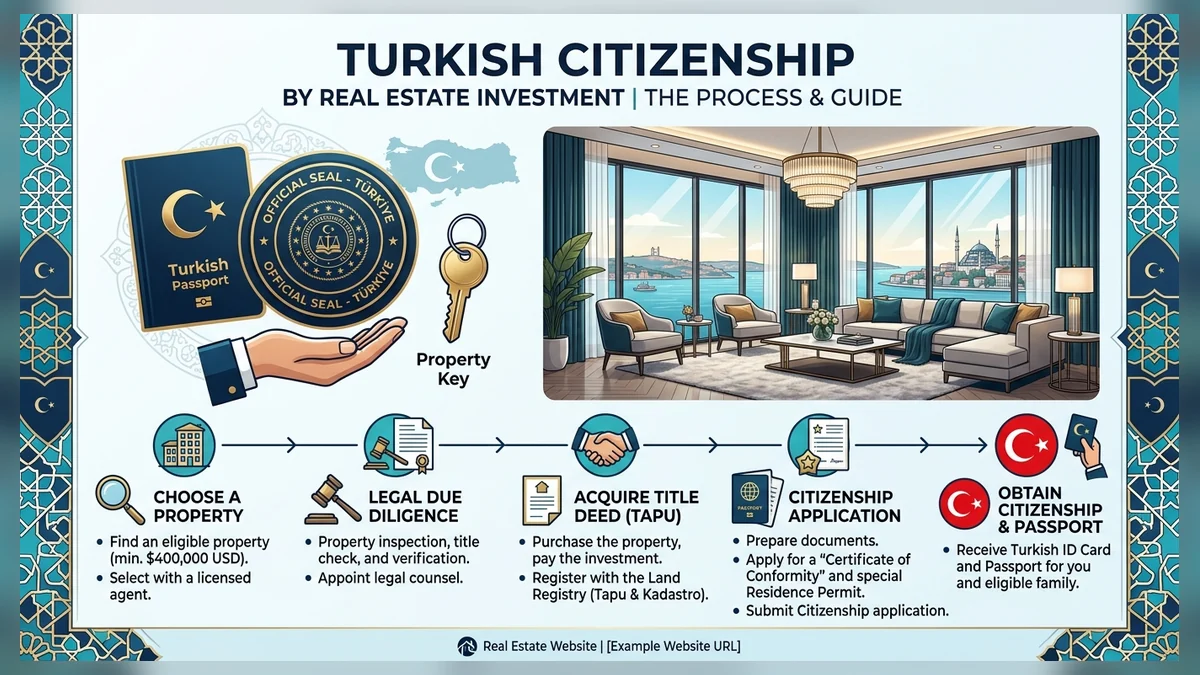
Current legal framework
Türkiye provides an exceptional citizenship route for qualifying foreign investors. Under the current official framework, a foreign natural person may qualify through real estate by acquiring property worth at least USD 400,000, or the foreign-currency equivalent, and placing the required restriction in the land registry so that the property is not sold for three years. The investment must be confirmed by the competent authority; buying an expensive property does not by itself guarantee citizenship.
This guide reflects official material reviewed in August 2026. Citizenship law and implementation circulars can change, and a person’s nationality, legal status, source of funds and transaction structure can affect the file. Always verify the current requirements before reservation or payment.
1. Separate property selection from citizenship eligibility
Do not begin with the phrase “citizenship eligible” in an advertisement. Begin with the legal file. The property, seller, transaction value, payment evidence and title-deed annotations must all support the citizenship application. A project may contain some units that can be structured for a citizenship file and others that cannot. Marketing language is not an official suitability certificate.
Before paying, review the exact parcel or independent unit, the registered owner, title restrictions, valuation requirements, seller relationship, payment route and the form of acquisition. If the proposed structure relies on a preliminary sales promise rather than a completed deed transfer, obtain specialist advice on the current rules before committing funds.
2. Understand the USD 400,000 threshold
Official Turkish sources currently state a minimum real-estate investment of USD 400,000 or equivalent foreign currency for the property route. The relevant legal and administrative documents determine how the amount is evidenced; a listing price or an informal agreement is not sufficient proof. The title-deed value, valuation documentation where required, bank payment evidence and the foreign-exchange process must be consistent with the transaction.
Do not try to close a gap in value with undocumented side payments. Citizenship review is an administrative/legal process, not merely a sales target, and discrepancies between declared price, bank movement and official records can jeopardize the file.
3. The three-year restriction is part of the investment condition
The land registry must contain the required commitment/restriction preventing disposal for at least three years. This is not a voluntary marketing promise; it is part of the official investment framework. Selling, transferring or structuring rights contrary to the registered restriction can affect the citizenship basis, so any later transaction during the restriction period should be reviewed legally before action.
4. Valuation and property-investment determination
Citizenship-purpose property transactions require the valuation and investment-determination process prescribed by the competent authorities. TKGM materials refer to the Taşınmaz Yatırımı Tespit Belgesi / suitability determination workflow. The purpose is to verify that the real-estate investment relied on for citizenship satisfies the applicable conditions; it is not replaced by a developer price list or an agent’s opinion.
Order and timing matter. Confirm what valuation documentation is required for the specific transaction before the deed stage, and ensure the property information in the valuation matches the land-registry record.
5. Foreign Exchange Purchase Certificate and bank evidence
For a foreign natural person purchasing real estate, the current TKGM foreign-exchange procedure requires the relevant currency to be sold through the banking mechanism and a Döviz Alım Belgesi to be issued for the title transaction. For citizenship-purpose acquisition, TKGM also requires evidence of the bank transfer from buyer to seller. These records should be planned as part of the legal file, not reconstructed after payment.
Use traceable bank channels. Ensure the parties, payment descriptions, amounts and timing correspond to the property and contract. Cash or opaque payment arrangements create avoidable evidentiary risk.
6. Title-deed annotation and suitability certificate
Once the transaction and required three-year undertaking are recorded, the land-registry authority transmits the transaction information to the authority responsible for the suitability determination. TKGM explains that when the suitability certificate is issued, the process then continues with the competent migration and population/citizenship authorities.
The suitability certificate is therefore a key administrative bridge between the property transaction and the later citizenship application. It should not be confused with a sales brochure, valuation report or ordinary Tapu.
7. Residence and citizenship application sequence
Official TKGM guidance states that after the suitability certificate, the investor proceeds to the relevant residence-permit stage and then the citizenship application before the population and citizenship authority. NVI administers citizenship applications, and exceptional citizenship remains subject to the statutory process and official decision. Meeting the investment condition does not remove public-order, national-security or file-integrity review.
8. Family and personal-file questions
Family inclusion, civil-status documents, dependent children, name consistency, translations, criminal/security checks and representation should be reviewed for the individual family before filing. Do not copy another investor’s document list blindly. Passport spellings and family records should be consistent across the property, banking, residence and citizenship files.
9. Common mistakes to avoid
- Buying first and asking about citizenship eligibility afterward.
- Relying only on an agent or developer statement that a unit is “citizenship suitable.”
- Using payment routes that cannot be clearly matched to buyer, seller and property.
- Ignoring title restrictions, mortgages or seller-related legal issues.
- Assuming the advertised price alone proves the qualifying investment value.
- Missing the required three-year land-registry annotation.
- Submitting translations or identity records with inconsistent names or dates.
- Treating the suitability certificate and final citizenship decision as the same thing.
10. due-diligence sequence
- Confirm the current citizenship threshold and implementation rules from official authorities.
- Check buyer eligibility and the exact property/title record.
- Review valuation and investment-determination requirements before payment.
- Plan the DAB and buyer-to-seller bank transfer evidence.
- Complete the deed transaction with the required three-year restriction.
- Obtain/confirm the official suitability determination.
- Proceed through the residence and citizenship application stages with the competent authorities.
- Retain the complete banking, valuation, deed and application file.
This guide is general information, not a guarantee of citizenship or a substitute for advice from a qualified Turkish lawyer or the competent public authorities.