
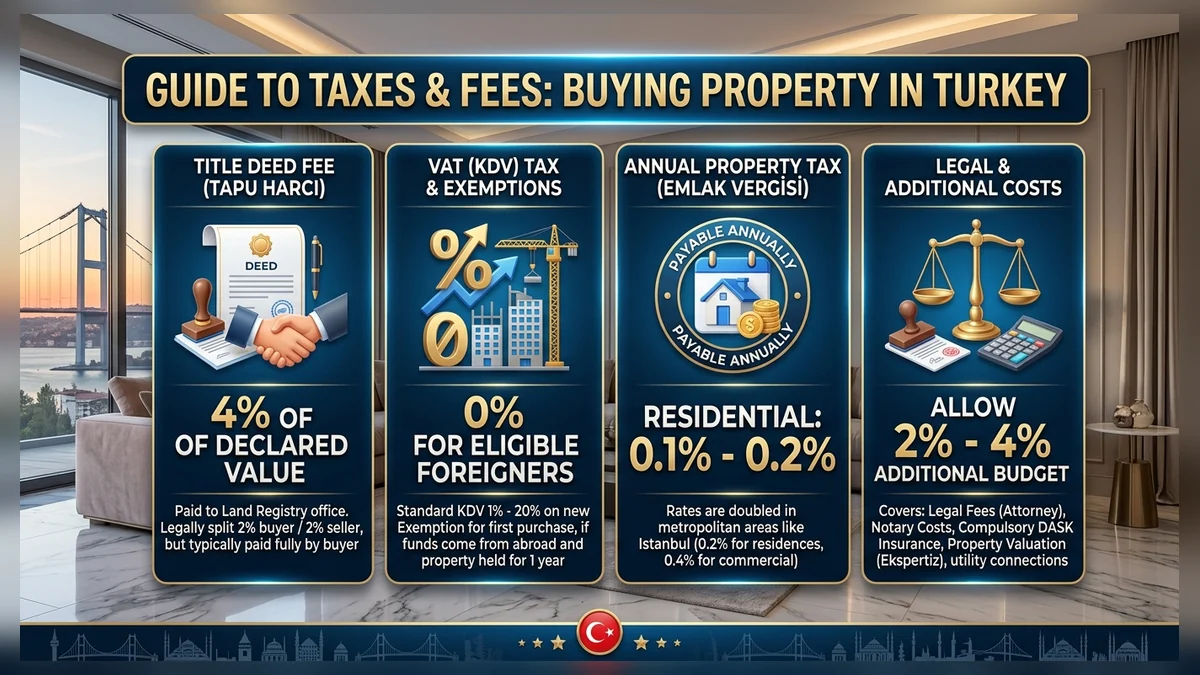
Municipal Property Tax Owner Checklist Core point Municipal property tax is tied to the tax value, taxpayer status and period, so review the municipality’s property record rather than estimating tax from market price alone. How to verify it After purchase check notification and liability timing with the competent municipality because title transfer does not eliminate administrative follow-up duties.
Decision impact Keep value notices, any exemption evidence and payment receipts by year so gaps can be identified at resale or review.
Taxes that depend on year and owner status
Rental income is governed separately by GİB rules, so distinguish rent actually received, deductible expenses, the chosen expense method and the resident/non-resident position of the owner. On exit, disposal of certain real property within five years of acquisition can fall under value-increase gain rules of the Income Tax Law, subject to the owner’s circumstances and statutory exceptions. Turn the review topic into provable facts: identity, date, amount, registry status, document or technical condition. Keep returns, receipts and cost evidence because they affect both verification and resale analysis.
A property tax file is not proved by one receipt. Municipal property tax depends on the tax value, property category and location, and GİB states that values calculated for 2026 are subject to a specific cap relative to 2025 values; obtain the current value and debt position from the competent municipality when it matters rather than carrying an old figure into a new year. The financial effect should be expressed in a traceable number—price, cash flow, tax, amount at risk or remediation cost—not in a vague label such as “acceptable”. For each fact use a source capable of proving it and link the result to its effect on purchase, ownership or cost. For each fact use a source capable of proving it and link the result to its effect on purchase, ownership or cost. Read this evidence together with the “Property identity and the current registry” review before relying on the conclusion.
Property identity and the current registry
Match the name and identity or legal-entity details, province, district, neighbourhood, ada/parsel and the independent-unit number where applicable. Read mortgages, attachments, annotations, easements and other restrictions before a material commitment. For each fact use a source capable of proving it and link the result to its effect on purchase, ownership or cost. Web Tapu allows applications for transactions such as sale, mortgage and inheritance transfer, but it does not make an earlier registry copy current evidence.
The financial effect should be expressed in a traceable number—price, cash flow, tax, amount at risk or remediation cost—not in a vague label such as “acceptable”. If a representative acts, check the representation document against the party’s identity, scope of authority and transaction type. A mismatch in unit, share, owner or a newly added restriction requires the file to be reconciled again before payment or completion. The current TKGM land-registry record is the starting point for proving the owner and the property; an old title-deed copy or an advertisement is not a substitute. Turn the review topic into provable facts: identity, date, amount, registry status, document or technical condition.
Payment trail and beneficiary proof
For each fact use a source capable of proving it and link the result to its effect on purchase, ownership or cost. Keep a reservation deposit, sale price and brokerage commission separate, and never replace an auditable banking trail with an oral confirmation. The payment path is part of transaction due diligence, not a separate bookkeeping step. Match beneficiary name, bank account, currency, amount and transfer reference to the contract and to the seller or properly authorised recipient, and independently verify any change in payment instructions before sending funds.
A request to use a new account, a third party or a route outside the agreed structure is a stop signal until authority and reason are resolved. TKGM also has specific foreign-exchange purchase-document instructions for foreign transactions where they apply, so not every bank receipt serves the same legal purpose. The financial effect should be expressed in a traceable number—price, cash flow, tax, amount at risk or remediation cost—not in a vague label such as “acceptable”. Preserve the transfer order, bank confirmation, posting evidence and a reference linking the transfer to the exact instalment. Turn the review topic into provable facts: identity, date, amount, registry status, document or technical condition.