
Checking title annotations and encumbrances in Turkey
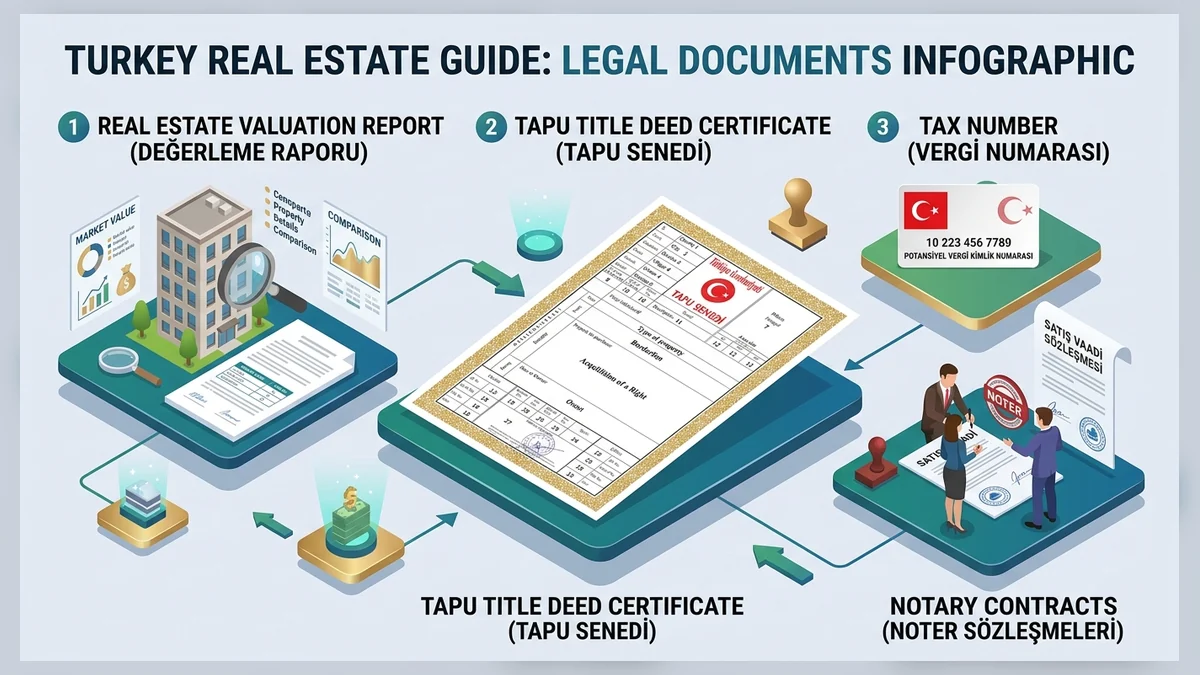
A title deed does not mean that the property is free from restrictions. TKGM uses the broad term takyidat for registered matters that restrict or affect ownership. Its official guidance includes annotations, declarations, easements, real-estate obligations, foundation notations and pledges or mortgages within that concept. A buyer therefore has to answer two separate questions: who is the registered owner, and what rights or restrictions are registered against the property? Confirming ownership without reviewing the second question is incomplete due diligence.
Use a current registry record
The controlling check should be based on a recent official registry record rather than an old image of a title deed or a copy supplied early in negotiations. TKGM Web Tapu allows owners to view their property information, obtain official documents such as a tapu kayıt örneği and authorize others to inspect information. TKGM Web Tapu documentation also refers to the ability to view matters such as attachments, mortgages and easement information. Timing matters because a restriction can be registered, amended or removed between the first viewing and the transfer date.
Read the entire takyidat set
Do not search only for the word ipotek. Review every relevant registry section and identify the type of entry, the beneficiary, the registration date, the reference number where available and whether the entry remains effective. Depending on the property, the record may include a bank mortgage, enforcement attachment, precautionary attachment, easement, usufruct, contractual annotation, pre-emption or purchase-related right, declaration or another registered matter. Different entries have different effects. Some may not stop a sale but can remain attached to the property; others require release, consent or another formal step before the buyer should proceed.
Convert every entry into a decision question. Does it restrict disposal? Will it survive the transfer? Is a terkin required? Who is entitled to consent to removal? Will the buyer bank require it to be cleared? Was the negotiated price based on an assumption that the property would be delivered free of the entry? If the legal consequence is unclear, the uncertainty should remain visible and be referred to the competent professional or registry source rather than being replaced by a sales explanation.
Practical workflow
- Confirm the exact property identity, including block, parcel and independent-unit number where applicable.
- Obtain a current official title record or authorized Web Tapu view that shows the relevant restrictions.
- List each takyidat separately with its type, date and beneficiary.
- Reconcile seller documents such as bank release letters or court decisions with the actual registry entry.
- Assign a disposition to every item: acceptable and continuing, must be removed before payment, requires consent, or blocks closing until resolved.
- Repeat the registry check immediately before or on closing when timing is material.
Red flags
Warning signs include a seller saying that a mortgage or attachment has been removed while it still appears in the official record, an undated release letter that does not identify the property correctly, reliance on a tapu senedi image instead of a current tapu kayıt örneği, an easement or annotation whose effect cannot be explained, or a new entry appearing after a deposit has been paid. A particularly important point is that the technical ability to transfer title does not necessarily mean an encumbrance is harmless. Some entries may remain economically or legally significant even where the registry transaction can proceed.
Closing and recordkeeping
Before releasing the final price, preserve the official record used for the decision, its retrieval date and every release or consent document, then reconcile the result once more with the live registry. Where mortgage or attachment removal is part of the payment sequence, the closing file should identify who pays whom, which document proves release, and what event authorizes release of the remaining funds. Older versions should not be discarded: they provide an audit trail showing when the entry existed, when it changed and how the buyer verified its resolution.
Official sources
- TKGM — Takyidat definition and title-record guidance
- TKGM — Web Tapu
- Official Web Tapu portal
- TKGM — Regulation on sharing title and cadastral data
Additional questions and context
What does title annotations, mortgages and encumbrances prove, and what does it not prove?
Start with a fresh registry extract and review all annotations, declarations, rights and mortgages; do not rely only on the title-deed image. Start with a fresh registry extract and review all annotations, declarations, rights and mortgages; do not rely only on the title-deed image. TKGM defines “takyidat” as the collective term for restrictions affecting ownership, including annotations, declarations, easements, real-estate obligations and pledges. The remedy is a fresh official check and a written note explaining the impact on price, payment, use, financing or closing.