
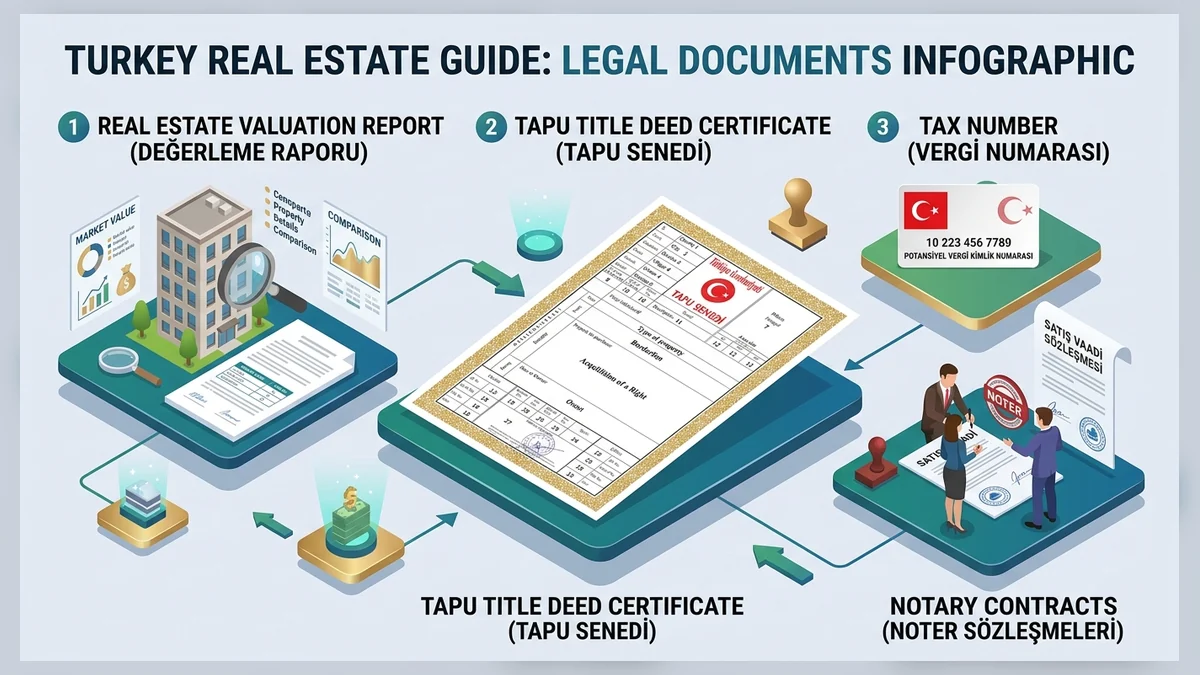
Closing-Day Check for Title annotations and encumbrances
If the agreement requires release of a mortgage or attachment, payment evidence alone is not enough; verify that deletion appears in the registry or that the official closing mechanism clearly resolves the entry. On closing day, review the newest available registry record before signature and transfer.
Closing-day encumbrance recheck
On the transfer day obtain a current electronic title/TAKBİS-Web Tapu view and re-check the property immediately before signature. Look for new Haciz, İpotek, usufruct/intifa, family-home annotations and any registered sale promise or right that could restrict the transfer. If a mortgage is being discharged, confirm the bank’s release/Fek documentation and coordinate payment so the encumbrance is actually removed or lawfully handled.
Required evidence
Keep the same-day electronic title extract, full Web-Tapu record, any bank mortgage-release letter and the transaction reference used for transfer. Compare the morning check with earlier due-diligence extracts to identify last-minute changes.
Decision points
If a new enforcement attachment appears, stop the unpaid balance and do not sign until the restriction is officially settled. A property can sometimes transfer with a mortgage only under a consciously structured legal/financial arrangement; never assume that the seller’s promise to “remove it later” is enough. Closing-day revalidation exists because the title can change after earlier due diligence.
Closing-day check for title annotations and encumbrances
A closing-day check is different from an earlier due-diligence review because the question is what is registered at the moment ownership is about to transfer. TKGM describes takyidat as the collective category for annotations, declarations, easements, real-estate obligations and pledges that restrict or affect ownership. Obtain a current property record and read the actual entries; a broker’s statement that “the title is clean” is not a substitute. Confirm the ada/parsel, independent unit and registered owner before interpreting any entry.
For every item, record its type, beneficiary/right holder, registration date and transaction reference where available, then establish whether it blocks transfer, requires a separate action, or is expected to remain after sale. Do not collapse a mortgage, attachment, easement, contractual annotation and administrative declaration into one risk label. Some rights may remain attached to the property without automatically preventing a sale, whereas a particular mortgage or attachment may need release or coordination. The legal effect must be established from the register and competent process, not inferred from a short label.
Evidence that release was requested is not evidence that the register is clear
A common closing failure is to rely on a letter saying a debt was paid while the entry is still visible. TKGM’s e-Terkin service supports digital removal of certain expired annotations, mortgages and attachments; for qualifying bank mortgages, release documentation can be sent electronically to the title office. For the buyer, however, the decisive control is the post-release register. Preserve the bank letter or release request as process evidence, then obtain a fresh record showing the resulting status.
Freeze the record used for the decision
Save the PDF or image of the register with retrieval time and property identity, and compare it with the earlier extract. A new entry appearing between first review and closing reopens the analysis even if every other document is complete. If an encumbrance is to be removed simultaneously with payment to a bank or creditor, write the sequence explicitly: who pays whom, where funds go, what evidence closes the entry, and when the remaining sale proceeds may be released to the seller.
The check closes only when every visible item has an evidenced explanation and execution status. “Nothing concerning” is not an adequate closing note; the file should show what was registered, what remained, and what was formally removed on a current official record.
Evidence and decision plan for Closing-Day Check for Title annotations and encumbrances
“Closing-Day Check for Title annotations and encumbrances” should be handled as a decision file, not as a collection of documents. Its working objective is to recheck the facts that can change at closing and make payment or signature conditional on the latest evidence. Evidence is useful only when it can be tied to the same property, party and decision date.
Evidence to assemble
- For “Closing-Day Check for Title annotations and encumbrances”, match the property and party identifiers in the evidence to the asset and people actually involved; a correct document for the wrong unit or person does not close the check.
- For “Closing-Day Check for Title annotations and encumbrances”, record issuer, source, issue or retrieval date and version where available, then distinguish an original/current record from a scan, translation, draft, expired copy or superseded version.
- For “Closing-Day Check for Title annotations and encumbrances”, compare documentary status with the physical, payment or operational reality relevant to the topic and write down every unexplained difference before commitment.
- For “Closing-Day Check for Title annotations and encumbrances”, convert each unresolved difference into a named condition: evidence required, person responsible, deadline and the consequence if the condition is not satisfied.
Official reference to recheck
The source register for “Closing-Day Check for Title annotations and encumbrances” includes TKGM — What is Takyidat? (https://www.tkgm.gov.tr/en/node/3347). Use that source for the matters within its authority and recheck it when timing or rules are material; it does not replace a registry, engineering, tax, banking or contractual record that the specific decision separately requires.
Decision boundary
The decision for “Closing-Day Check for Title annotations and encumbrances” is not “document present / document absent.” It is whether the evidence is current, identifies the right asset and parties, resolves material conflicts and supports the next irreversible step.