
Safer property payment and closing with Web Tapu
Web Tapu is the official digital service of Türkiye’s General Directorate of Land Registry and Cadastre (TKGM). It can help an owner view registered property information, obtain certain officially valid documents, submit applications, upload documents, grant or revoke defined access to third parties, and use anti-fraud declarations. These functions are valuable in a property transaction, but Web Tapu should be understood as part of a controlled closing process—not as a payment guarantee or an escrow service. A buyer still needs to verify the exact property, seller authority, current registry position, payment beneficiary and the timing of each transfer.
Use official registry evidence before moving money
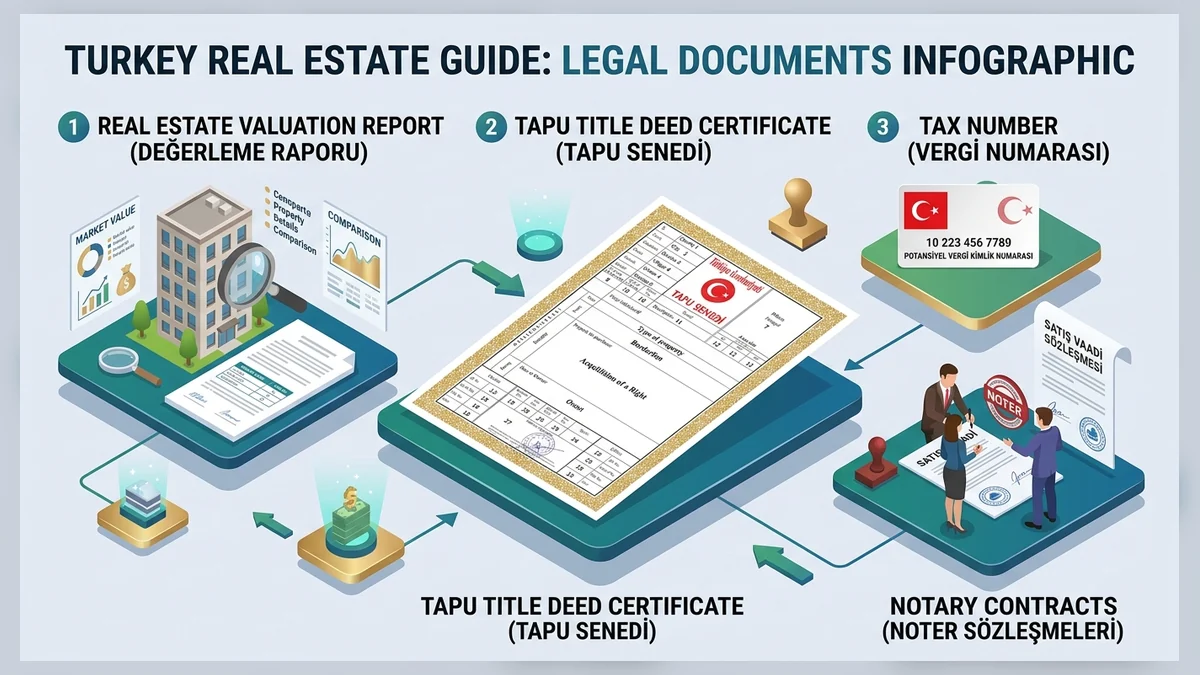
Before a material deposit or closing payment, identify the property by province, district, neighbourhood, block/parcel and, for condominium property, the exact independent-unit details. TKGM states that owners can obtain current, officially valid title-deed, mortgage and land-registry documents electronically through Web Tapu after the required process and payment. The buyer should use current official evidence rather than relying on an old title image, a screenshot from a sales representative or a document that cannot be connected to the unit being purchased. The registry should also be reviewed for mortgages, attachments, annotations, easements and other restrictions relevant to the transaction.
Verify the seller and every representative
The person communicating with the buyer is not necessarily the person legally entitled to sell the property. Match the registered owner to official identity evidence. If a representative signs, review the power of attorney and confirm that it covers the actual sale and any payment-related authority being exercised. If the seller is a company, check the legal entity and the current authority of the representative. Web Tapu can support controlled information-sharing and applications, but a broker’s access to view title information or submit an application does not automatically authorise that broker to sign the sale, receive the purchase price or redirect funds.
Control the beneficiary account independently
Payment fraud often occurs when an otherwise genuine transaction is diverted at the final stage. The seller’s bank account and beneficiary name should be documented in the signed transaction file before the balance is due. If a new IBAN, beneficiary or payment route appears later—especially through email, messaging software or a rushed phone call—pause the payment. Confirm the change through a contact channel independently verified earlier and obtain written evidence explaining why payment to the new beneficiary satisfies the buyer’s obligation. A bank transfer to an unexplained third party should never be justified merely by saying that the project or broker “uses this account”.
Link each payment to an objective milestone
Reservation money, contractual instalments and the closing balance should each have a defined purpose and condition. A reservation payment should identify the exact property, recipient, refund rules and the period for which the property is held. A larger contractual payment should follow the due-diligence conditions agreed by the parties. The final balance should be coordinated with the title-transfer process and any mortgage release or other registry action required by the contract. For foreign-natural-person purchases, the DAB and banking sequence required by current TKGM rules should be prepared before closing. Citizenship transactions have additional valuation, bank-evidence and annotation requirements and should not be treated as ordinary sales with a different marketing label.
Use Web Tapu’s security features correctly
TKGM explains that Web Tapu lets owners place or remove a declaration preventing a disposition without the owner appearing in person, which is designed as an anti-fraud measure. Owners can also authorise third parties or real-estate professionals to inspect property information or make defined applications and can revoke that authority. These features reduce certain identity and document risks, but they do not replace buyer-side controls. The buyer must still confirm what authority has actually been granted and whether the official application corresponds to the agreed property and parties.
Read the official transaction again before signing
Closing-day pressure is not a reason to lower the standard of verification. Compare the official transaction information with the signed commercial agreement: property identifiers, registered owner, buyer, transferred share, declared sale value and any representative. If the property number, owner, share or restriction differs from the reviewed file, stop and resolve the discrepancy before payment and signature. Recheck the current registry close to transfer because a document obtained early in negotiations may no longer reflect the live position.
Create a complete payment and title trail
After completion, retain the signed agreement, reservation and instalment receipts, bank-transfer evidence, DAB where applicable, official fee receipts, the final title/registry evidence and the documents supporting any mortgage discharge or other condition. The file should make it possible to answer four questions without guesswork: which property was purchased, who sold it, where the money went and when legal ownership transferred. Web Tapu strengthens that evidence chain by providing official digital access and transaction tools; safe payment comes from combining those tools with disciplined identity, registry, beneficiary and timing controls.