
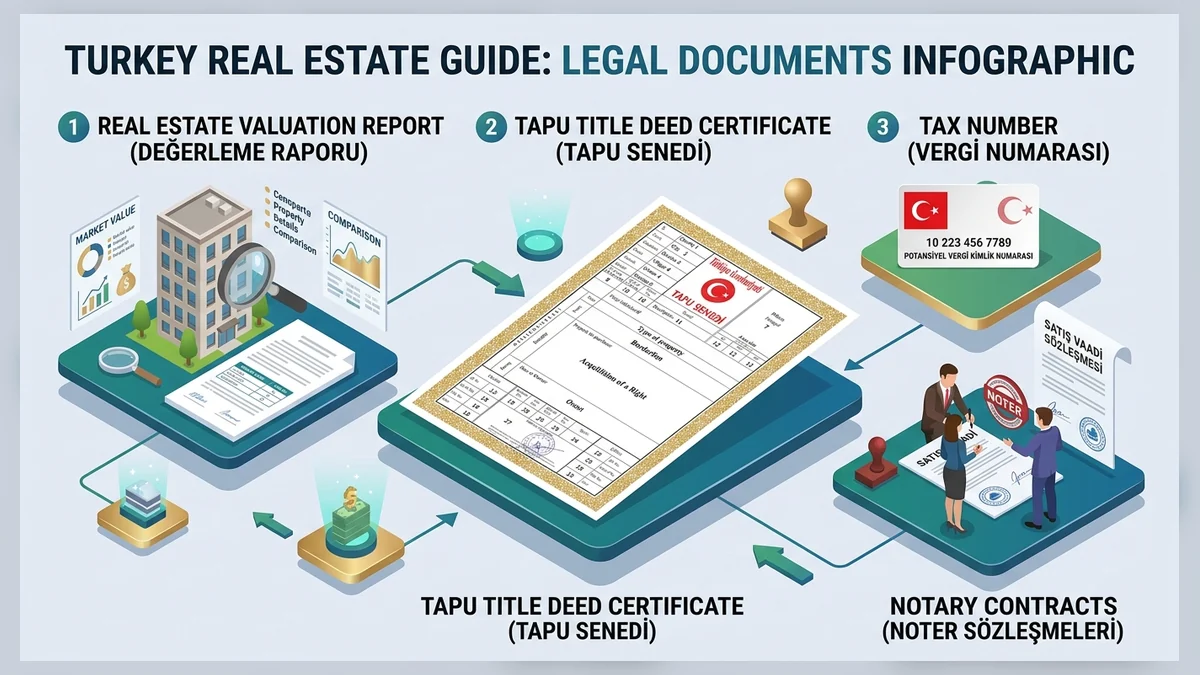
Title Transfer Fees Workflow Guide in Türkiye
Title-transfer charges should never be treated as one unexplained number copied from a listing, a chat message or a previous transaction. A defensible closing file starts by identifying the transaction type, the agreed sale price and the property-tax value, then separates statutory title-deed tax from TKGM revolving-fund service charges and from private costs such as brokerage, legal or translation fees. Each category has a different basis, payee and supporting receipt.
Step 1: Confirm the transaction type and property
Before calculating anything, confirm that the transaction is an ordinary sale rather than a gift, partition, exchange or another legal transfer, because the applicable charge rules can differ. Tie the cost file to the official property identifiers: province, district, neighborhood, block and parcel and, where applicable, the independent-unit number. A project marketing name or reservation number is not enough.
Step 2: Establish the value base
TKGM’s current sale guidance states that the title-deed fee for a sale is calculated on the declared sale value, which may not be lower than the municipal property-tax value. Obtain or confirm the current property-tax value through the competent channel and record the actual agreed sale price in the transaction file. If the parties are being asked to declare a figure that does not reflect the real commercial arrangement, do not treat that difference as a harmless cost-saving technique. It is a legal and financial discrepancy that requires review before any declaration is made.
Step 3: Calculate the buyer and seller title-deed fees separately
TKGM’s official sale page states that, under the referenced fee schedule, the buyer and the seller are each charged 20 per thousand on the qualifying declared value. In the closing worksheet, show the buyer amount and seller amount as separate lines even if the parties have a private agreement under which one party economically bears more of the total. A private allocation between buyer and seller should be documented separately; it should not obscure how the official charge is assessed.
Step 4: Separate the revolving-fund service charge
The TKGM döner sermaye charge is not the same as title-deed tax and should not be converted into an invented percentage. TKGM publishes a separate tariff and announced that the 2026 tariff took effect on 1 January 2026. Use the tariff in force on the transaction date and do not rely on an amount from an old closing because service charges can change with the tariff and the type of service.
Step 5: Build a fee-reconciliation worksheet
Create a simple worksheet showing the agreed sale price, municipal property-tax value, declared transfer value, buyer title-deed fee, seller title-deed fee, applicable revolving-fund charge and each private cost in its own row. Record the source and verification date for each official figure. This exposes errors early, such as using last year’s value or hiding a broker commission inside a line labelled “government fees.”
Step 6: Wait for the official collection reference
Do not send a government charge to a private bank account because someone says it is faster. TKGM’s e‑Tahsilat service supports payment of title-deed and cadastral fees and revolving-fund charges using the official collection number; TKGM states that the e‑Tahsilat number is 12 or 13 digits. Match the reference to the correct transaction before paying and use an official electronic or banking channel supported by the system.
Step 7: Verify payer, amount and payment purpose
Immediately before authorising payment, verify the party, application or collection reference, amount and charge type. If a second message arrives with a different figure, investigate the reason rather than paying both. Keep the purchase price, title-deed fee, revolving-fund charge and private professional charges distinct. A clear file should allow a new reviewer to explain every lira without guessing.
Step 8: Capture and reconcile the receipt
After payment, retain a readable official receipt showing the reference, amount, date and payment channel. Record who paid each charge and reconcile all receipts back to the worksheet. If one party pays another party’s amount under a private contractual arrangement, retain that arrangement separately from the government receipt so that the official transaction evidence remains clear.
Step 9: Recheck before registration
Before the final appointment or signature, confirm that all charges required for the current transaction have been settled and that each receipt belongs to the same application and property. A payment made under the wrong reference or for another file should be corrected through the competent channel, not “fixed” by editing a screenshot.
Step 10: Close the cost file after registration
After registration, preserve the official receipts with the sale contract and relevant payment evidence. This supports later accounting, tax review, financing and resale. Do not assume that every amount paid at closing has the same tax treatment in a future capital-gain calculation; that is a separate tax question that should be checked against current GİB guidance when it becomes relevant.
Mandatory stop points
- The declared value is below the applicable property-tax value or does not reconcile with the transaction file.
- The requested payment cannot be tied to an official collection reference.
- A government charge is requested through a personal account or an unknown link.
- Title-deed tax, revolving-fund fees and private commission are bundled into one unexplained amount.
- A new amount or payee appears at the last minute without a documented reason.
Frequently asked questions
Is the title-deed fee the same as the TKGM revolving-fund fee?
No. They are separate charge categories with different legal and administrative bases and should appear as separate lines in the closing file.
Can buyer and seller agree that one side pays more?
They can contractually allocate the economic burden between themselves, but the parties should still understand the official assessment and preserve the private allocation separately.
Can I reuse last year’s fee figure in 2026?
Not safely. In particular, revolving-fund charges follow the tariff in force. Use the current tariff and the official collection reference generated for the present transaction.
What is the most important proof after payment?
A readable official receipt that can be matched to the collection reference, transaction and amount, supported by a reconciliation worksheet explaining the total closing cost.
This workflow is practical and informational and does not replace independent legal or tax advice for unusual transactions or special exemptions.