
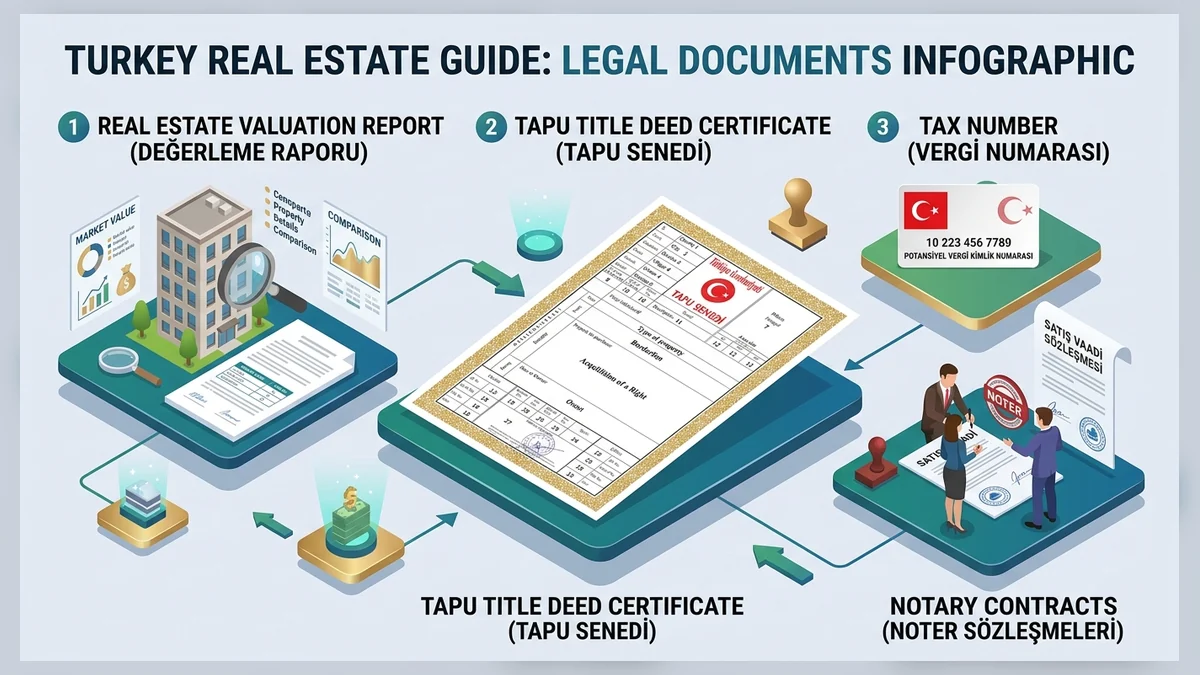
Title annotations and encumbrances Recordkeeping Guide
Keep the before-and-after registry extracts, mortgage document where relevant, release/deletion request or proof, and any consent from the right holder. This creates an auditable chain showing what existed and what changed. title annotations and encumbrances: Paying a mortgage debt does not by itself remove the mortgage from the registry; TKGM says the bank sends the release document electronically to the Land Registry Directorate for cancellation.
Record uncertainty explicitly instead of assuming clean status.
Core question
Failure scenario
A title extract is not reliable for recordkeeping if it belongs to another date, unit, or transaction. Save the current registry evidence together with the exact property identifiers and retrieval date.
Required evidence
Independent check
If a mortgage appears but its release or current status cannot be verified, preserve both the original encumbrance entry and the official evidence that later confirms continuation or release.
A common failure pattern is that mortgage appears correct while release/current status is missing, stale or linked to another record.
At closing, recordkeeping should distinguish a title that is generally correct from annotations that remain unresolved. Each restriction should have its own status, responsible party, evidence, and closing consequence.
The review must connect title with annotations using evidence from the same asset and the same decision date.
Test annotations independently before using verification as supporting evidence.
A complete file should show the history of each mortgage, seizure, annotation, declaration, or easement from discovery through resolution rather than replacing earlier evidence with only a final summary.
If a restriction will be cleared from sale proceeds, link payment release to a closing mechanism that verifies the discharge rather than relying on the seller’s promise.
Read the type, beneficiary, scope and release mechanism from a current title record; seeing the owner’s name does not mean the registry is restriction-free.
Takyidat covers registered mortgages, attachments, annotations, easements and other restrictions that may affect transfer or use.
For any entry intentionally left on title after transfer, retain the exact registry wording and the advice or analysis used to accept it; a shorthand label such as “minor annotation” is not sufficient for a later lender or buyer.
Preserve the encumbrance record as a time-stamped chain
For each mortgage, attachment, annotation, easement or other restriction, retain the current registry evidence together with the date obtained, the right holder/creditor, amount or scope where stated, and the instrument or transaction reference. If a restriction is later released, keep both the pre-release evidence and the registration of deletion rather than overwriting the old file. This is especially important where money is released against a promised discharge: the audit trail should show the burden before payment and the registry state after the discharge procedure.
When several burdens exist, track each one separately to its own release or continuing status. A clean result for one mortgage must not be used to imply that an attachment, easement or different annotation has also disappeared. The closing file should state which entries remain after the intended discharge.
Evidence and decision plan for Title annotations and encumbrances Recordkeeping Guide
The due-diligence purpose of “Title annotations and encumbrances Recordkeeping Guide” is to preserve source, date, version, property identifiers and the final conclusion so another reviewer can reproduce the file. A reviewer should be able to trace every material conclusion to a current source and identify any assumption that has not yet become evidence.
Evidence to assemble
- For “Title annotations and encumbrances Recordkeeping Guide”, match the property and party identifiers in the evidence to the asset and people actually involved; a correct document for the wrong unit or person does not close the check.
- For “Title annotations and encumbrances Recordkeeping Guide”, record issuer, source, issue or retrieval date and version where available, then distinguish an original/current record from a scan, translation, draft, expired copy or superseded version.
- For “Title annotations and encumbrances Recordkeeping Guide”, compare documentary status with the physical, payment or operational reality relevant to the topic and write down every unexplained difference before commitment.
- For “Title annotations and encumbrances Recordkeeping Guide”, convert each unresolved difference into a named condition: evidence required, person responsible, deadline and the consequence if the condition is not satisfied.
Official reference to recheck
The source register for “Title annotations and encumbrances Recordkeeping Guide” includes TKGM — What is Takyidat? (https://www.tkgm.gov.tr/en/node/3347). Use that source for the matters within its authority and recheck it when timing or rules are material; it does not replace a registry, engineering, tax, banking or contractual record that the specific decision separately requires.
Decision boundary
For “Title annotations and encumbrances Recordkeeping Guide”, a residual issue should remain open whenever its legal, technical, tax, payment or cost consequence cannot yet be measured. The file is ready only when that issue is closed or consciously accepted by the appropriate decision-maker.