
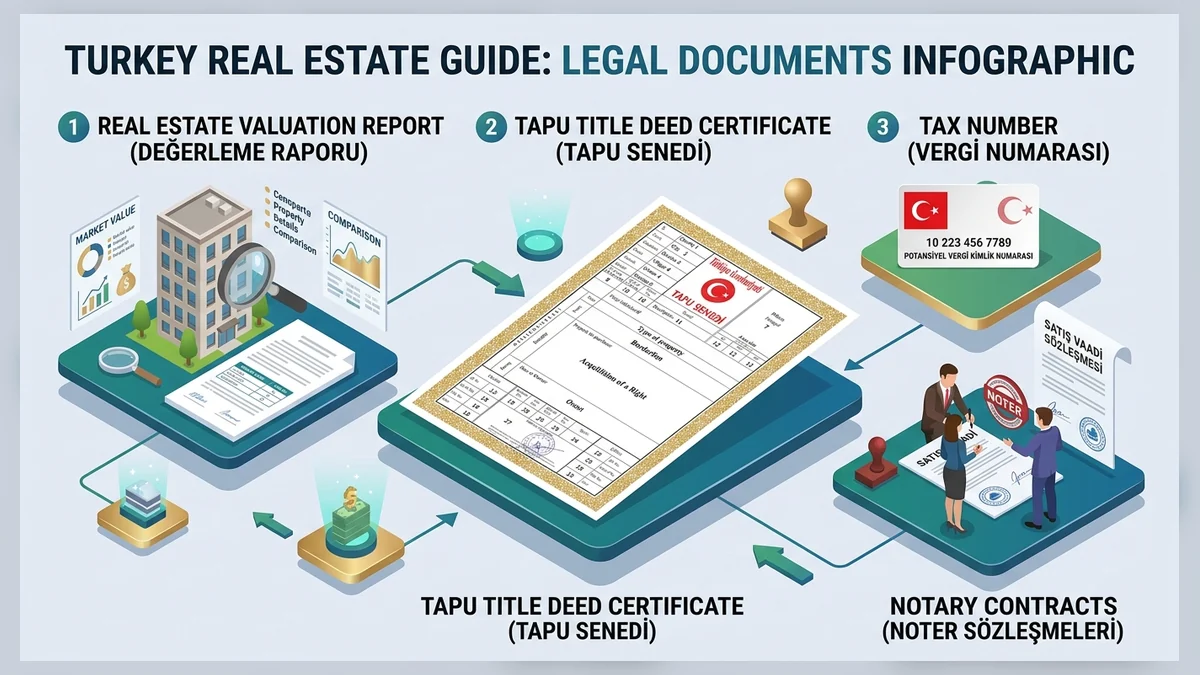
Ownership Share Ratio — Due-Diligence Workflow
A reliable arsa payı review is easiest when it follows the life of the transaction rather than checking the fraction once at the end. The purpose of this workflow is to prevent the buyer from signing a contract for an independent unit whose registered ownership share differs from the unit presented by the seller. The workflow starts with property identity, moves through documentary comparison and ends with a final title check immediately before completion.
1. Identify the property before analysing the share
Collect the exact province, district, neighbourhood, ada/parsel, block, floor and independent-unit number. Obtain the current title record for that unit. Only after the legal object is fixed should the reviewer transcribe the arsa payı fraction. This order matters: comparing a correct ratio from the wrong unit gives a false sense of accuracy.
2. Read numerator and denominator as one figure
Enter the share exactly as registered, including both numerator and denominator. If spreadsheets are used for comparison, keep the original fraction beside any percentage conversion. Avoid “rounding” a fraction in the transaction file. A later reviewer should be able to reproduce the comparison from the official record without reconstructing what was meant.
3. Compare the condominium or construction-servitude project
Where project material is available, check the same independent unit in the approved project and the schedule used to establish the condominium or construction servitude. TKGM guidance states that land shares are attached to independent units and that the allocation of the shares across units forms part of the legal structure. The comparison is not intended to recalculate architectural value from scratch; it is intended to detect whether the unit and the registered share have been mismatched or altered.
4. Investigate every document that shows another ratio
Old title deeds, management files, valuation reports or developer schedules may show historical information. Place each document on a timeline. If an older fraction changed, identify the registration or correction that produced the current fraction. A private spreadsheet should not be used to override the registry. Conversely, a current registry figure should not be accepted blindly if the file contains credible evidence that the wrong independent unit has been referenced.
5. Separate the share from neighboring issues
The workflow should not turn into a general property audit. It does not calculate tax, earthquake risk or DASK coverage. It can, however, note a neighboring issue when it is necessary to interpret the share—for example, if two units were legally merged or divided, or if a project amendment changed unit identity. The question remains: what share is legally attached to the independent unit being acquired?
6. Resolve discrepancies before payment milestones
If the fraction in the sales contract differs from the title record, ask the seller to identify the legal basis for the difference. If correction is promised, make the correction measurable: which authority will complete it, what document will evidence completion, and whether payment or title transfer is conditional on that evidence. Avoid informal solutions such as editing the contract number while leaving the registry inconsistency unexplained.
7. Recheck at closing
Use a fresh land-registry record at or near completion. Confirm that the independent-unit identity and arsa payı remain unchanged and that no intervening transaction affected the unit. Store the record used for the closing decision together with the contract version and the project document relied upon.
The workflow is complete when the buyer can trace the ratio from the independent unit in the current registry to the relevant project history and explain any historical change. If that chain is incomplete, the ratio is not ready to be treated as verified merely because a plausible fraction appears on paper.
Official sources
- TKGM guidance on condominium ownership and construction servitude.
- Law No. 634 on Condominium Ownership.
Additional questions and context
Which identifiers must match when checking land share (Arsa Payı) verification?
Use a chain: current registry → independent-unit number → land-share numerator/denominator → total shares in the building → Kat İrtifakı/Kat Mülkiyeti establishment documents. If totals or allocation appear inconsistent, pause reliance on the ratio until the registry or competent authority explains the discrepancy. Use a chain: current registry → independent-unit number → land-share numerator/denominator → total shares in the building → Kat İrtifakı/Kat Mülkiyeti establishment documents. If totals or allocation appear inconsistent, pause reliance on the ratio until the registry or competent authority explains the discrepancy. This record applies that evidence specifically to land share (Arsa Payı) verification, and should be reconciled to the exact property rather than generalized from another unit.
What mismatch is most important to investigate in land share (Arsa Payı) verification?
Use a chain: current registry → independent-unit number → land-share numerator/denominator → total shares in the building → Kat İrtifakı/Kat Mülkiyeti establishment documents. If totals or allocation appear inconsistent, pause reliance on the ratio until the registry or competent authority explains the discrepancy. Use a chain: current registry → independent-unit number → land-share numerator/denominator → total shares in the building → Kat İrtifakı/Kat Mülkiyeti establishment documents. If totals or allocation appear inconsistent, pause reliance on the ratio until the registry or competent authority explains the discrepancy. For land share (Arsa Payı) verification, preserve the current official record, its date and the identifiers used to reach the conclusion.
What evidence closes that mismatch — land share (Arsa Payı) verification?
Use a chain: current registry → independent-unit number → land-share numerator/denominator → total shares in the building → Kat İrtifakı/Kat Mülkiyeti establishment documents. If totals or allocation appear inconsistent, pause reliance on the ratio until the registry or competent authority explains the discrepancy. Use a chain: current registry → independent-unit number → land-share numerator/denominator → total shares in the building → Kat İrtifakı/Kat Mülkiyeti establishment documents. If totals or allocation appear inconsistent, pause reliance on the ratio until the registry or competent authority explains the discrepancy. For land share (Arsa Payı) verification, an unresolved conflict remains a transaction condition until the competent record or authority resolves it.