
Title Transfer Fee Reconciliation Before Closing
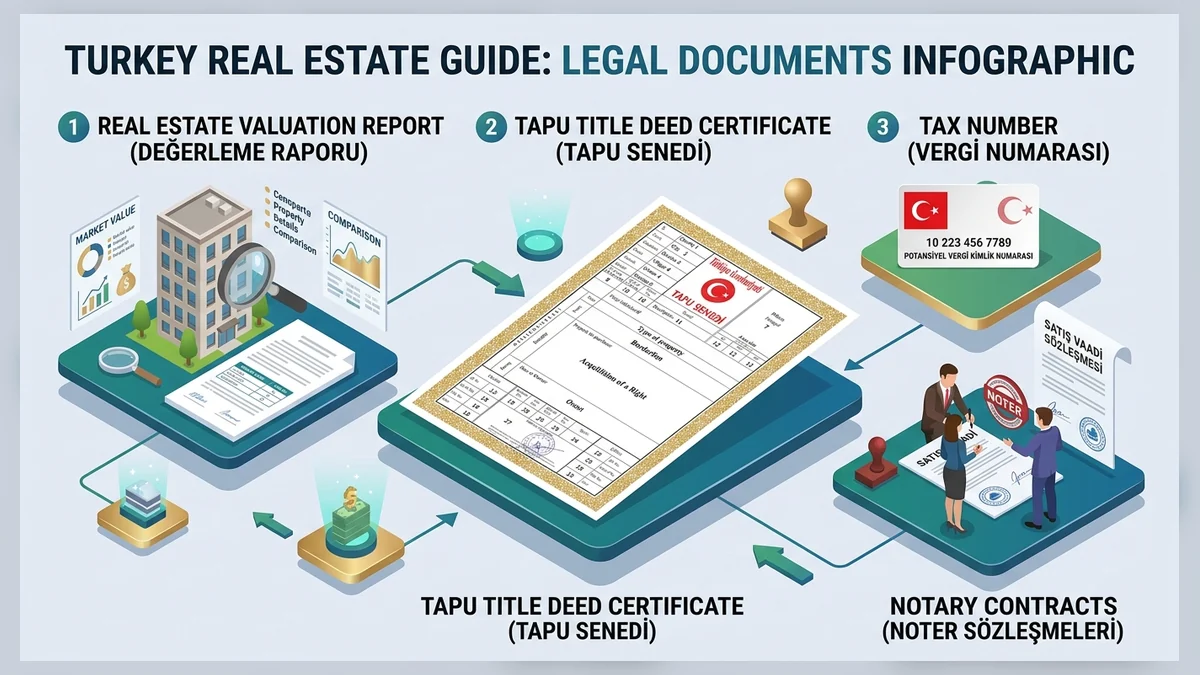
Title-transfer fees should be reconciled against the actual transfer file, not estimated from a listing. The declared transfer value, municipal property-tax value, official fee assessment, bank payment and final receipt should all refer to the same property and transaction date.
Reconcile the fee base
For a sale, the title-deed fee is calculated on the declared transfer value, which cannot be below the property-tax value. The legal rate is ordinarily 20 per thousand for the buyer and 20 per thousand for the seller; the TKGM revolving-fund service charge is separate.
Match the documents
Compare the sale contract, municipal value, Web Tapu or title-transfer application, bank-payment evidence and official fee receipt. A different amount or property identifier should be resolved before transfer rather than explained after closing.
Keep other requirements separate
Foreign-buyer valuation, DAB and citizenship evidence can affect the wider file but are not substitutes for the title-fee calculation and receipt. Preserve the final assessment and payment record with the title document.
Evidence and decision plan for Cross-Party Consistency Check — Title transfer fees
When reviewing “Cross-Party Consistency Check — Title transfer fees”, the file should compare the same names, property identifiers, amounts, dates and obligations across every relevant party and document. This makes the article useful at the point of commitment because unresolved facts are separated from verified facts instead of being buried in narrative.
Evidence to assemble
- For “Cross-Party Consistency Check — Title transfer fees”, match the property and party identifiers in the evidence to the asset and people actually involved; a correct document for the wrong unit or person does not close the check.
- For “Cross-Party Consistency Check — Title transfer fees”, record issuer, source, issue or retrieval date and version where available, then distinguish an original/current record from a scan, translation, draft, expired copy or superseded version.
- For “Cross-Party Consistency Check — Title transfer fees”, compare documentary status with the physical, payment or operational reality relevant to the topic and write down every unexplained difference before commitment.
- For “Cross-Party Consistency Check — Title transfer fees”, convert each unresolved difference into a named condition: evidence required, person responsible, deadline and the consequence if the condition is not satisfied.
Official reference to recheck
The source register for “Cross-Party Consistency Check — Title transfer fees” includes TKGM — Web Tapu and title transactions (https://www.tkgm.gov.tr/en). Use that source for the matters within its authority and recheck it when timing or rules are material; it does not replace a registry, engineering, tax, banking or contractual record that the specific decision separately requires.
Decision boundary
A defensible conclusion on “Cross-Party Consistency Check — Title transfer fees” records both what was verified and the limits of that verification. If a missing fact could change ownership, legality, safety, cost or payment security, it should block the related commitment until resolved.
Second-pass review for Cross-Party Consistency Check — Title transfer fees
A second-pass review of “Cross-Party Consistency Check — Title transfer fees” should test whether the first conclusion would survive a change of reviewer. Start from the underlying source rather than the previous summary, repeat the identity match, and check whether a later document, payment, amendment or physical change has altered the answer. The source review should return to the controlling TKGM title-transfer and fee evidence, verify that the same property and transaction are being assessed, and record the retrieval date so that another reviewer can reproduce the fee conclusion.
For “Cross-Party Consistency Check — Title transfer fees”, keep a short discrepancy log that states the fact in question, the two conflicting pieces of evidence, the competent source chosen to resolve the conflict, and the transaction step held back while the discrepancy remains open.
At handover or file closure, “Cross-Party Consistency Check — Title transfer fees” should leave a compact evidence package: the controlling document or source extract, supporting correspondence or technical evidence, the dated conclusion, and any condition the buyer accepted. This improves resale and future auditability without pretending that old evidence stays current forever.
Closure package for Cross-Party Consistency Check — Title transfer fees
Before treating “Cross-Party Consistency Check — Title transfer fees” as complete, verify that the evidence package answers four separate questions: what exactly was checked, which source had authority for that fact, when the source was checked, and what decision followed. Keeping those four elements together prevents a later reader from mistaking a recommendation for proof.
If “Cross-Party Consistency Check — Title transfer fees” depends on more than one discipline, keep the boundaries explicit. A land-registry result should not be used as an engineering opinion, an insurance policy should not be used as a structural certificate, a tax value should not automatically become market value, and a marketing representation should not replace an official or contractual record.