
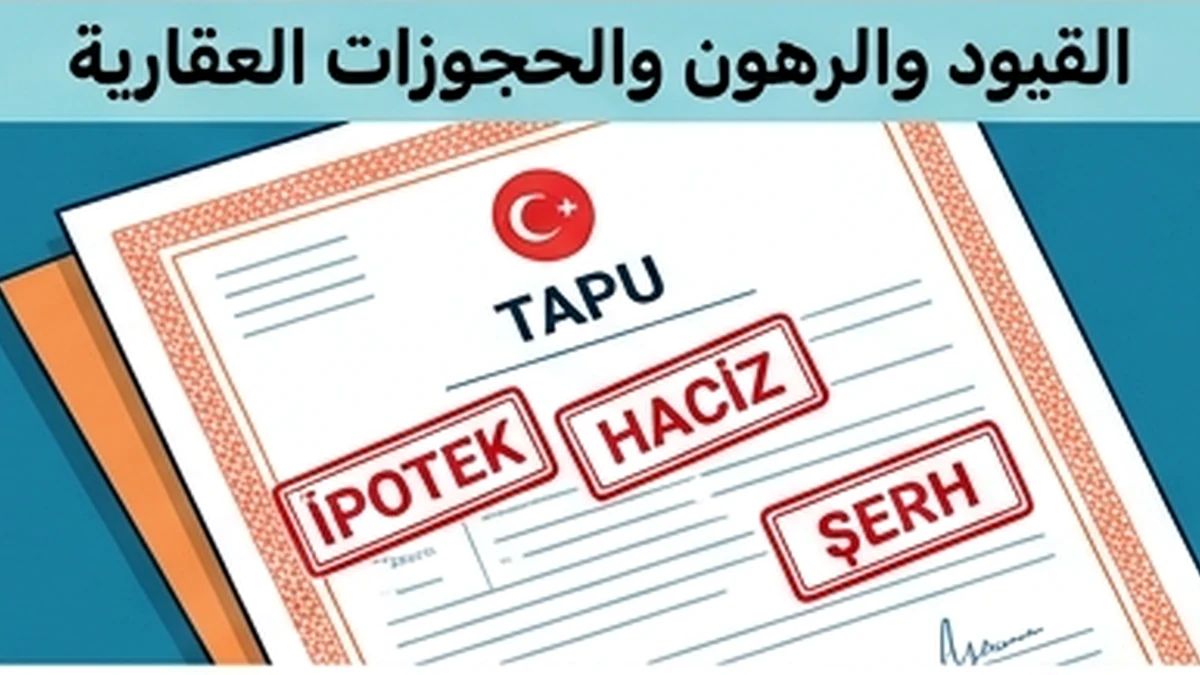
Core point
A mortgage or attachment release is proved by discharge in the registry or an independently verifiable official release, not the seller’s promise or a debt-payment receipt alone.
How to verify it
Read the restriction identity, scope/amount and beneficiary to make sure the release concerns the same registered entry on the same property.
Decision impact
If sale proceeds will repay the debt, use a simultaneous-closing structure that links transfer of funds to the agreed official discharge step.
Do not treat a seller’s screenshot, old deed copy or bank statement as proof that a mortgage or lien is absent. Web Tapu can display current encumbrance information such as mortgage, attachment, declarations and easements, and TKGM permits official current registry and mortgage documents to be obtained. Match the exact parcel and independent unit, record the creditor or authority, the entry type and date, and keep the current registry evidence in the acquisition file before any material payment.
A mortgage or lien release check is unreliable when the evidence is stale, belongs to another unit, or cannot be tied to the current registry. Confirm the exact encumbrance, creditor or authority, release step, and current registry status before treating the burden as cleared.
Start with the exact title identifiers, then obtain a current registry view or official record. Separate mortgage, attachment/seizure, annotation, declaration and easement entries instead of calling all of them simply ‘debt’. For each entry identify the beneficiary or authority, the legal effect that needs clarification, and the evidence required for release or continuation. Recheck after any promised release step and again near transfer because the registry can change between an early review and closing.
The presence of an encumbrance is a trigger for investigation, not a universal conclusion that a sale is impossible. The practical risk depends on the type of entry, its beneficiary, whether it remains active, what transaction is proposed and what release evidence is available. Treat an unexplained mortgage, attachment or conflicting annotation as a payment-control issue: do not rely on verbal assurances that it ‘will disappear later’; require a current registry check and documented release path.
Retain the current title/registry extract, mortgage document where relevant, any electronic or official release evidence, correspondence identifying the responsible bank or authority, and the final recheck. Label documents by retrieval date because registry information is time-sensitive. A useful file should allow a later reviewer to reconstruct: what entry existed, what evidence explained it, what action removed or accepted it, and what the registry showed at completion.
Classify each registry entry into four buckets: understood and acceptable; acceptable only with a documented release at or before transfer; requires specialist or authority clarification; or unacceptable for the planned transaction. The decision should be tied to evidence in the official registry. If a mortgage is said to be paid, TKGM states that the relevant bank sends the electronic release document to the land registry for deletion; payment of the debt alone should not be confused with completed deletion from the registry.
Ask the seller for the current registry/encumbrance record, not only the deed image. For a mortgage ask which bank or creditor holds it, whether the debt is fully paid, whether an electronic release has been sent, and when deletion will appear in the registry. For an attachment or other restriction ask which authority placed it and what formal act is needed to remove it. Confirm answers against TKGM/Web Tapu evidence rather than messages or broker statements.
Evidence and decision plan for Mortgage and Lien Release Check
“Mortgage and Lien Release Check” should be handled as a decision file, not as a collection of documents. Its working objective is to build a clear, evidence-based answer to the topic itself. Evidence is useful only when it can be tied to the same property, party and decision date.
Evidence to assemble
- For “Mortgage and Lien Release Check”, match the property and party identifiers in the evidence to the asset and people actually involved; a correct document for the wrong unit or person does not close the check.
- For “Mortgage and Lien Release Check”, record issuer, source, issue or retrieval date and version where available, then distinguish an original/current record from a scan, translation, draft, expired copy or superseded version.
- For “Mortgage and Lien Release Check”, compare documentary status with the physical, payment or operational reality relevant to the topic and write down every unexplained difference before commitment.
- For “Mortgage and Lien Release Check”, convert each unresolved difference into a named condition: evidence required, person responsible, deadline and the consequence if the condition is not satisfied.
Official reference to recheck
The source register for “Mortgage and Lien Release Check” includes TKGM — Web Tapu (https://www.tkgm.gov.tr/web-tapu-23). Use that source for the matters within its authority and recheck it when timing or rules are material; it does not replace a registry, engineering, tax, banking or contractual record that the specific decision separately requires.
Decision boundary
The decision for “Mortgage and Lien Release Check” is not “document present / document absent.” It is whether the evidence is current, identifies the right asset and parties, resolves material conflicts and supports the next irreversible step.