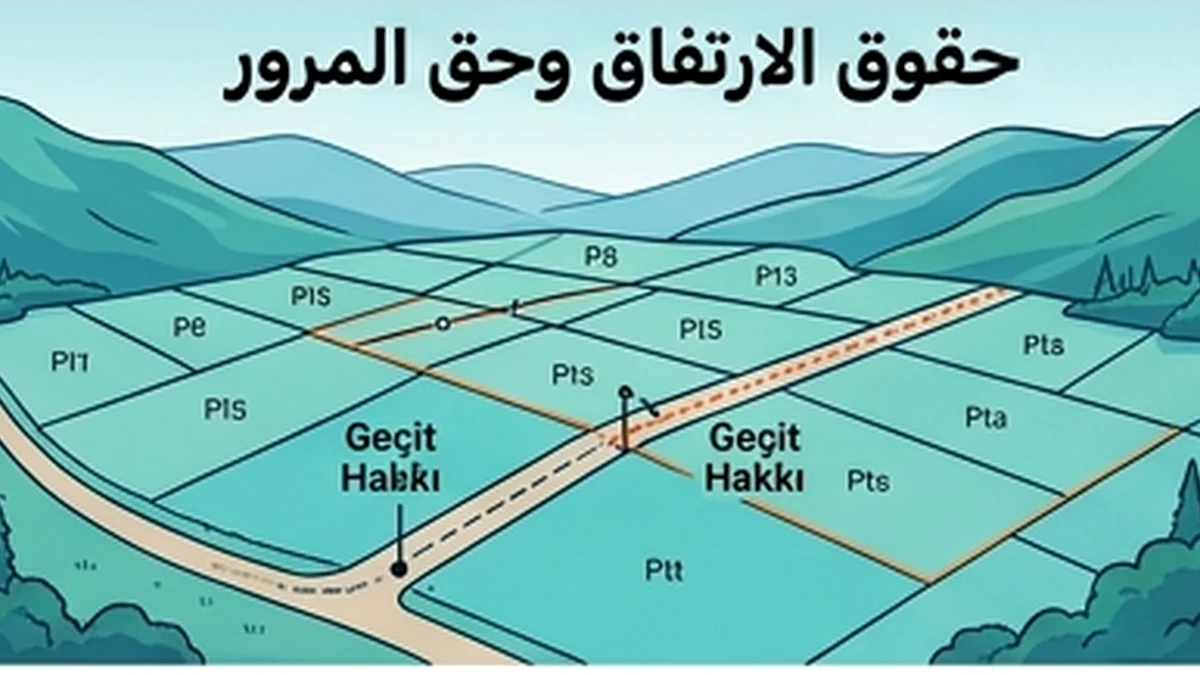
How a buyer should verify easement rights
An easement is not a minor note on a title record. It is a limited real right that can allow another person or property to use the burdened property in a defined way, or require the owner to tolerate or refrain from certain conduct. The Turkish Land Registry Regulation provides for easements to be registered in the dedicated registry column. For easements created in favour of another property, the registry links the benefited property and the burdened property and identifies the nature of the right. A buyer should therefore treat an irtifak as part of the legal structure of ownership.
What to extract from the registry
Start with a current tapu kayıt örneği and identify the type of irtifak, the beneficiary or benefited parcel, the burdened parcel, any stated duration, and the registration reference and date. Some rights are connected to another property, such as rights of way or utility passage; some are personal rights such as usufruct or residence depending on their legal form. Independent and permanent easement rights can also have separate registration treatment when statutory conditions are met. Never assume that every irtifak means a right of way. The precise type and scope determine its effect.
Reconcile the registry with the plan and ground
The registry proves that a right exists, but the buyer also needs to understand how the right works physically. For a right of way, identify the route and width and ask whether the road actually used is the registered route. For a utility easement, identify whether electricity, water, gas, drainage or another facility crosses the land and whether that corridor affects building or maintenance. Where the right depends on a plan or sketch, keep that technical document with the registry entry rather than relying on a short text description. The Land Registry Regulation also provides for property easements to be shown on the relevant plan.
The gap between registration and physical occupation can be important. A track may have been used for years without a registered right; a registered route may no longer be obvious on the ground; or a building may have been constructed close to the easement corridor. These issues should not be resolved by visual inspection alone. Reconcile the registry with cadastral and technical material, and obtain a professional measurement or interpretation if the exact location is material.
Decision questions
- Is the property being purchased benefited by the easement or burdened by it?
- What is the right: geçit, mecra, usufruct, building right or another easement?
- Is there a duration, condition, payment or maintenance obligation?
- Does the right legally support the access on which the property actually depends?
- Does the easement corridor conflict with an existing building or proposed development?
- Will a lender or future buyer require additional evidence or clarification?
Red flags
Warnings include practical access with no clear legal right, a registered right of way whose route cannot be identified, disagreement between the plan, fence and road, a utility corridor crossing the buyer proposed building area, or a usufruct allowing another person to use the property after ownership changes. Removal should not be treated as an informal seller promise. A terkin requires the appropriate legal basis and registry procedure.
Purchase decision and recordkeeping
An easement can be beneficial, for example by securing access, or burdensome by reducing privacy or development potential. It should not automatically be labelled a defect. Evaluate the effect on intended use, price, financing and resale. Preserve the current registry record, any plan or sketch, the instrument establishing the right where available, and a written conclusion explaining why the buyer accepts the easement, requires a change before closing or decides not to proceed.
Official sources
Frequently asked questions
What should remain in the evidence file after completing “Easement rights Verification Guide”?
For “Easement rights Verification Guide”: Example: the file contains benefited property, but registry entry cannot be verified. Do not mark “Easement rights Verification Guide” complete. Keep the issue open, obtain a current official record and document whether the mismatch changes payment, price, use, finance or closing. Retain the source or primary document, its date/version, the exact property or counterparty identifier, the reviewer’s conclusion and the document that closes any exception. That record makes the decision reproducible instead of dependent on memory or a sales statement.
Which official source is most useful for “Easement rights Verification Guide”, and what does it establish?
For “Easement rights Verification Guide”: TKGM describes Web Tapu as the official online channel for applications such as sale, mortgage and inheritance transfer; a current registry record should therefore be preferred to an advertisement or an old document image when identity or rights are being checked. Primary source used for the 16 August 2026 recheck: TKGM — Tapu ve Kadastro Genel Müdürlüğü. Keep the source URL and the transaction-specific evidence together; the source explains the rule or system, while the property file must prove how it applies to the exact unit or transaction.
For “Easement rights Verification Guide”, what should be verified before the information is relied on?
For “Easement rights Verification Guide”: This article has one purpose: resolve the question raised by “Easement rights Verification Guide” for the topic Easement rights. Start with benefited property and burdened property, and tie both to the exact property, party and transaction date. Use this guide as a decision aid, not a glossary entry: identify the exact property or transaction, collect the primary evidence named here, and record the conclusion, date and unresolved exception before relying on it.
What should be checked about closing with an unresolved family-home issue before reselling the property in family residence annotation, specifically closing with an unresolved family-home issue?
A family-residence annotation can directly affect an owner’s ability to dispose of the property alone. Checking only the registered owner is insufficient: review the annotations, family-home status and spouse-related evidence before commitment or payment. Proceed only when disposition authority is clear; otherwise hold until the annotation/consent issue is resolved. For this exact point—“closing with an unresolved family-home issue” within family residence annotation—use the cited source to establish the governing rule for the same property and current transaction.
How should “Usufruct can affect possession, rental income, financing and resale value” be applied specifically in Usufruct Rights on Property Guide?
Usufruct can affect possession, rental income, financing and resale value. The purchase contract should state whether the right remains, is released before transfer or is priced into the transaction.
How should “Check the land-register entry for the holder, scope, duration or” be applied specifically in Usufruct Rights on Property Guide?
Check the land-register entry for the holder, scope, duration or termination basis of the usufruct; do not infer these terms from who currently occupies the property.
What should be checked about effect on value and resale before reselling the property in right of way (Geçit Hakkı), specifically effect on value and resale?
A right of way (Geçit Hakkı) is an easement that identifies the beneficiary, the burdened property and the permitted route/scope. A physical track does not by itself prove a legal right of way, and a registered right still requires review of its route and effect. Proceed when legal access, route and practical usability are aligned; hold for establishment, clarification or amendment where access remains uncertain. For this exact point—“effect on value and resale” within right of way (Geçit Hakkı)—use the cited source to establish the governing rule for the same property and current transaction.
What is the legal or financial effect of paylı versus elbirliği ownership in co-owner rights and share sale?
For co-owned property, first identify the ownership form, registered share and who can dispose of the interest being sold. A share sale, sale of the whole property, conversion between co-ownership forms and pre-emption rights are distinct issues and should not be conflated. Which share is sold, who owns the remainder, whether all owners sign, and what pre-emption or use arrangements exist. For this exact point—“paylı versus elbirliği ownership” within co-owner rights and share sale—use the cited source to establish the governing rule for the same property and current transaction.
How should “A usufruct (intifa hakkı) separates the right to use and” be applied specifically in Usufruct Rights on Property Guide?
A usufruct (intifa hakkı) separates the right to use and benefit from property from bare ownership. A buyer of bare ownership can acquire title while the usufruct holder retains registered use/benefit rights.