
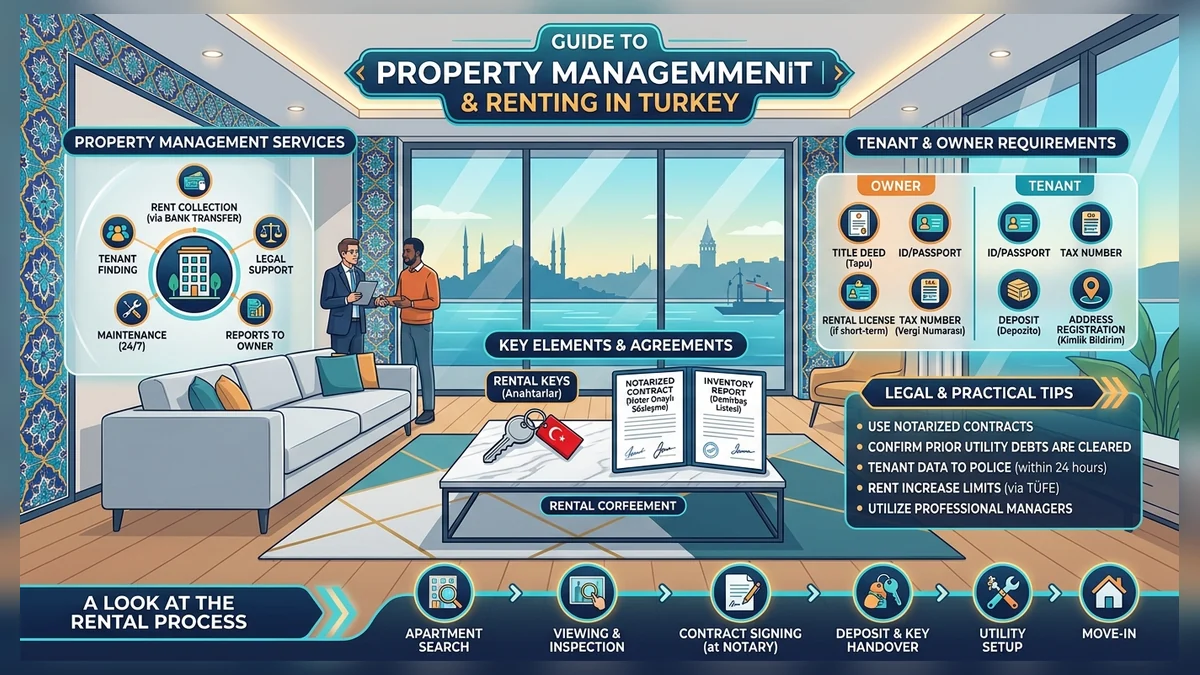
Tenant Occupancy Status Recordkeeping Guide
A strong tenant file is not a folder full of screenshots. It is a controlled record that allows the new owner to prove who occupies the property, which lease governs, what was paid or notified, what remains disputed, and what transferred with ownership. This is particularly important when an occupied property is sold because Article 310 of the Turkish Code of Obligations makes the new owner a party to the lease after ownership changes. If the evidence is not transferred with the transaction, the buyer may inherit a legal relationship without the records needed to manage it.
1. Create one master index
Start with the property address, independent-unit identifier, former and new owner, tenant or occupant, title-transfer date and an internal reference for every document. Divide the file into lease documents, payments, deposit, notices, condition/inspection, correspondence, disputes and owner-transition material. A master index prevents the latest signed version from disappearing among email attachments and messaging-app images.
2. Preserve the governing lease and its history
Keep the signed lease plus every appendix, renewal, rent amendment or later written agreement. Record the date and source of each version. If two signed versions conflict, do not delete one. Preserve both and create a discrepancy note identifying the difference and the resolution adopted by the parties or legal adviser. Version control matters because a later dispute may turn on a date, amount or possession promise that appeared only in one copy.
3. Maintain a month-by-month payment ledger
For each rental month, record rent due, amount paid, payment date, method, bank description or receipt reference, and any shortfall or dispute. This is more useful than a single statement saying the tenant “is current” or “owes money.” Article 315 addresses default in due rent or ancillary expenses, while Article 352 includes situations involving justified notices. A chronological ledger allows the owner to connect any legal notice to the payment event that caused it.
4. Treat the security deposit as a separate liability record
Record the deposit amount and currency, where it is held, when it was paid, what the lease says, and what the seller and buyer agreed about responsibility after the sale. Preserve any opening-condition report or photographs available from the beginning of the tenancy. When the lease eventually ends, those records help distinguish original condition, ordinary wear and damage that may be disputed.
5. Keep every notice together with proof of service
A draft notice is not evidence of delivery. For each notice, retain the final text, date, sender, recipient, delivery method and proof of receipt or outcome. If the notice triggers a statutory period, add a file note recording the calculated start and end date based on the legal advice applied to that file. This avoids the later question: “Was the notice ever served, and when did the clock start?”
6. Record possession, inspections and access
Keep inspection records, dated photographs, maintenance requests and access communications. Article 319 concerns access to the leased property to the extent necessary for maintenance, sale or later reletting, while requiring appropriate advance notice and regard for the tenant’s interests. The file should therefore document reasonable requests and responses rather than preserving only one party’s accusation.
7. Prepare an owner-transition memorandum on the sale date
This is one of the most valuable documents in the file. State the governing lease, current rent, last paid period, arrears or disputed amounts, deposit, keys, contact details, pending notices, open repair requests and the next known deadline. Attach an inventory of what the buyer actually received. Do not write a generic list of what should exist; identify the documents that were handed over and any missing item that remains a seller obligation.
8. Separate formal disputes from ordinary correspondence
Once mediation, litigation or enforcement begins, create a separate folder using the official file reference and dates. From 1 September 2023, rental disputes are generally subject to mandatory mediation before litigation under Article 18/B of Law No. 6325, except the statutory non-judgment enforcement eviction route. The new owner should be able to see the latest procedural step and the next deadline without reconstructing the dispute from casual messages.
9. Apply data minimisation and access control
Tenant files can contain identity, address, bank and communication data. Keep only information needed to administer the relationship, comply with legal duties or support a defined claim. Limit access. When sending material to a property manager, accountant or legal adviser, share the relevant portion rather than automatically forwarding the complete identity and banking file.
10. Use version numbers for changing records
Payment ledgers, handover notes and issue lists should carry an update date and responsible person. Do not overwrite a version that supported an earlier decision without preserving the historical copy. When rent changes, a notice is served, arrears are cured or a dispute is settled, update the index and link the change to its supporting document.
11. Link every important statement to evidence
Replace vague phrases such as “tenant is compliant” with a reference such as “payments through July verified by bank transfers A–G.” Replace “tenant will vacate” with the specific legal document reviewed, or label the expected vacancy as an unresolved condition. Evidence-linked wording allows a future property manager or lawyer to reconstruct the file without depending on the seller’s memory.
12. Define review triggers
Re-open the record when ownership changes, rent is revised, the lease is renewed, a notice arrives, mediation/litigation starts, the actual occupant changes, a deposit is paid or returned, or a handover is agreed. A yearly housekeeping review is also useful to confirm that the lease, contact details and payment ledger still reflect the real relationship.
Closing-file checklist
- Signed lease and amendments indexed.
- Actual occupant identified.
- Payment ledger current through transfer date.
- Deposit amount and responsibility documented.
- Notices include service evidence.
- Property condition and access history preserved.
- Any dispute has a file number and procedural status.
- Owner-transition memorandum lists what the buyer actually received.
Conclusion: the value of recordkeeping becomes visible months after a sale when memories differ. A professional occupancy file does more than tell a story. It proves which version governed, when an event occurred, how a notice was served, what money changed hands and how the tenancy and deposit responsibilities were transferred to the new owner.