
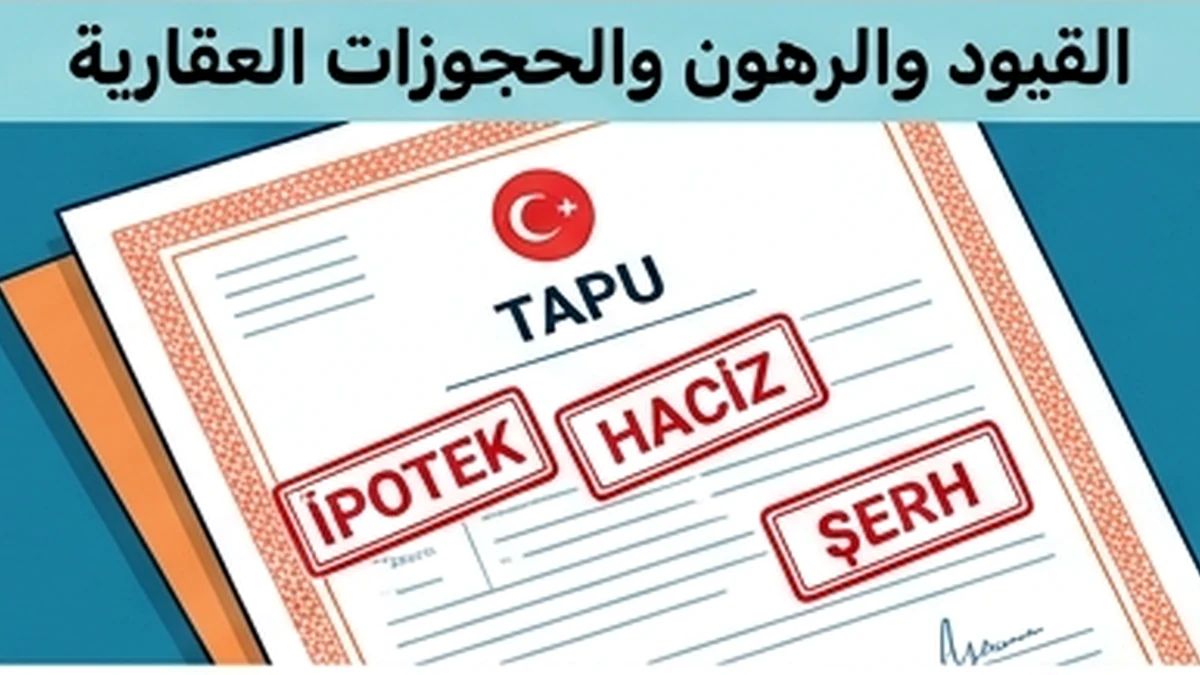
Mortgage and lien status Risk Review
This edition of “Mortgage and lien status Risk Review” was rebuilt to remove boilerplate and turn the page into a practical decision reference. External facts below are tied to primary/official sources; any conclusion about a specific unit still requires unit-specific evidence.
Verified facts relevant to this topic
Required work
- likelihood of the problem
- size of possible loss
- detectability before payment
- party bearing the downside
- evidence that reduces uncertainty
- threshold for walking away
Topic-specific review matrix
The conclusion for “Mortgage and lien status Risk Review” should end in one of three states: verified/actionable, actionable subject to written dated conditions, or stop until the conflict is resolved. A page quality score is not a substitute for the transaction decision.
Official sources
- TKGM — Tapu ve Kadastro Genel Müdürlüğü — 15 August 2026
- TKGM — Land Registry Procedures Guide — 15 August 2026
- TKGM — Parcel Query — 15 August 2026
Assess risk by legal effect, not by label alone
Practical questions answered from primary sources
Can mortgage rank / priority change whether a mortgage and lien status transaction can proceed?
The presence of an encumbrance is a trigger for investigation, not a universal conclusion that a sale is impossible. The practical risk depends on the type of entry, its beneficiary, whether it remains active, what transaction is proposed and what release evidence is available. Treat an unexplained mortgage, attachment or conflicting annotation as a payment-control issue: do not rely on verbal assurances that it ‘will disappear later’; require a current registry check and documented release path. For this exact point—“mortgage rank / priority” within mortgage and lien status—use the cited source to establish the governing rule for the same property and current transaction.
Which document gives the current answer on mortgage rank / priority in mortgage and lien status, specifically mortgage rank / priority?
The presence of an encumbrance is a trigger for investigation, not a universal conclusion that a sale is impossible. The practical risk depends on the type of entry, its beneficiary, whether it remains active, what transaction is proposed and what release evidence is available. Treat an unexplained mortgage, attachment or conflicting annotation as a payment-control issue: do not rely on verbal assurances that it ‘will disappear later’; require a current registry check and documented release path. For the document check on “mortgage rank / priority” within mortgage and lien status, match the official identifiers, date, authority and scope to the closing file; a related document for another unit or older version is not enough.
What should be rechecked immediately before payment in mortgage and lien status, specifically mortgage rank / priority?
The presence of an encumbrance is a trigger for investigation, not a universal conclusion that a sale is impossible. The practical risk depends on the type of entry, its beneficiary, whether it remains active, what transaction is proposed and what release evidence is available. Treat an unexplained mortgage, attachment or conflicting annotation as a payment-control issue: do not rely on verbal assurances that it ‘will disappear later’; require a current registry check and documented release path. For the risk question on “mortgage rank / priority” within mortgage and lien status, treat any unresolved mismatch as a live transaction issue until the competent record or authority shows the required status.
Sources checked: 16 August 2026.
Additional source-verified evidence
Official source: TKGM FAQ
Evidence and decision plan for Mortgage and lien status Risk Review
For “Mortgage and lien status Risk Review”, the practical objective is to identify the material ways the topic can fail, then connect each risk to evidence and a transaction consequence. The review should distinguish what is proved now, what still depends on a missing or stale document, and what difference that gap makes to price, signing, payment, handover or later resale.
Evidence to assemble
- For “Mortgage and lien status Risk Review”, match the property and party identifiers in the evidence to the asset and people actually involved; a correct document for the wrong unit or person does not close the check.
- For “Mortgage and lien status Risk Review”, record issuer, source, issue or retrieval date and version where available, then distinguish an original/current record from a scan, translation, draft, expired copy or superseded version.
- For “Mortgage and lien status Risk Review”, compare documentary status with the physical, payment or operational reality relevant to the topic and write down every unexplained difference before commitment.
- For “Mortgage and lien status Risk Review”, convert each unresolved difference into a named condition: evidence required, person responsible, deadline and the consequence if the condition is not satisfied.
Official reference to recheck
The source register for “Mortgage and lien status Risk Review” includes TKGM — General FAQ / Mortgage Release (https://www.tkgm.gov.tr/sss). Use that source for the matters within its authority and recheck it when timing or rules are material; it does not replace a registry, engineering, tax, banking or contractual record that the specific decision separately requires.
Decision boundary
Close “Mortgage and lien status Risk Review” only when the conclusion can be reproduced from evidence by another reviewer. A reasonable outcome may be proceed, proceed subject to a written condition, reprice, obtain specialist advice, or stop; uncertainty should remain visible instead of being converted into a positive statement.