
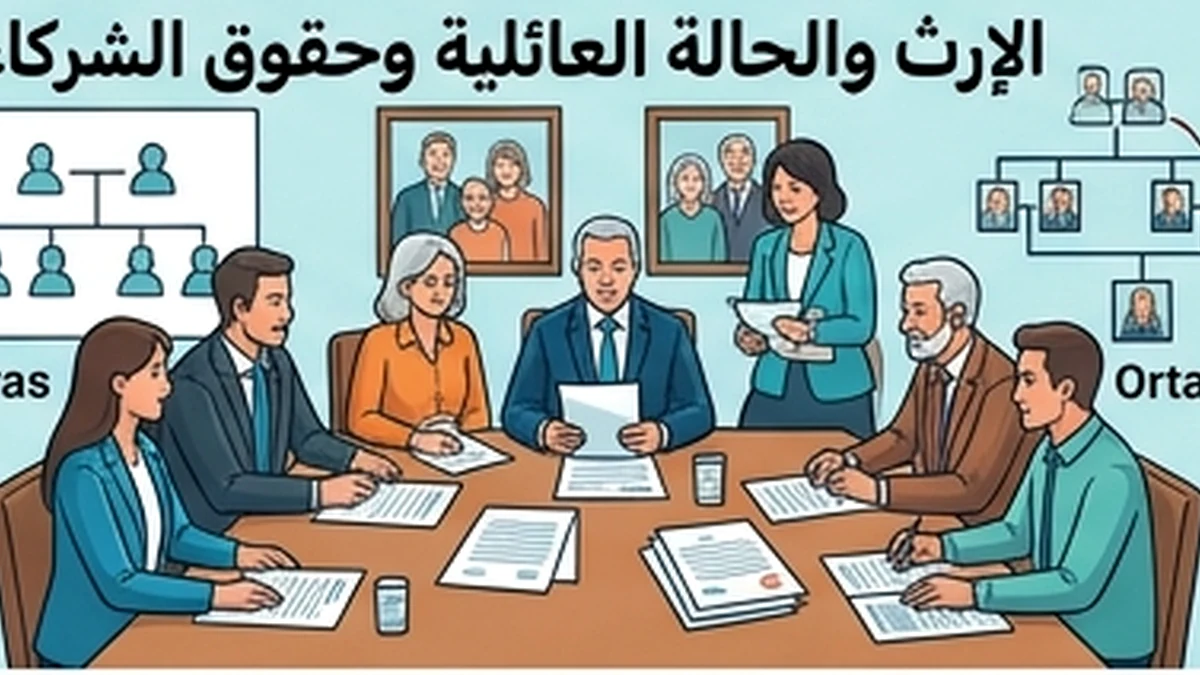
Inheritance ownership records Workflow Guide
This edition of “Inheritance ownership records Workflow Guide” was rebuilt to remove boilerplate and turn the page into a practical decision reference. External facts below are tied to primary/official sources; any conclusion about a specific unit still requires unit-specific evidence.
Verified facts relevant to this topic
Required work
- start point and inputs
- official-verification gate
- property-matching stage
- conflict-resolution stage
- final-version approval
- payment or closing release
Topic-specific review matrix
The conclusion for “Inheritance ownership records Workflow Guide” should end in one of three states: verified/actionable, actionable subject to written dated conditions, or stop until the conflict is resolved. A page quality score is not a substitute for the transaction decision.
Official sources
- TKGM — Tapu ve Kadastro Genel Müdürlüğü — 15 August 2026
- TKGM — Land Registry Procedures Guide — 15 August 2026
- TKGM — Parcel Query — 15 August 2026
Auditable workflow
Obtain inheritance certificate → identify the exact property → register or verify inheritance transfer → map heirs and authority → check tax/clearance constraints → prepare the later sale or partition.
Practical questions answered from primary sources
How can a buyer verify who the heirs are in inheritance ownership records?
Inherited property requires three separate checks: who the heirs are under the inheritance certificate, how ownership has been transferred into the title register, and whether tax or registry conditions affect a later disposition. Known heirs do not automatically mean the title is ready for sale. Obtain inheritance certificate → identify the exact property → register or verify inheritance transfer → map heirs and authority → check tax/clearance constraints → prepare the later sale or partition. For this exact point—“who the heirs are” within inheritance ownership records—use the cited source to establish the governing rule for the same property and current transaction.
Which names, dates or numbers must match for who the heirs are in inheritance ownership records, specifically who the heirs are?
Obtain inheritance certificate → identify the exact property → register or verify inheritance transfer → map heirs and authority → check tax/clearance constraints → prepare the later sale or partition. The goal is to show the visitor what the evidence proves, what it does not prove, and the next check required before signing or payment. For the document check on “who the heirs are” within inheritance ownership records, match the official identifiers, date, authority and scope to the closing file; a related document for another unit or older version is not enough.
What discrepancy in who the heirs are should delay signing in inheritance ownership records, specifically who the heirs are?
The goal is to show the visitor what the evidence proves, what it does not prove, and the next check required before signing or payment. For the risk question on “who the heirs are” within inheritance ownership records, treat any unresolved mismatch as a live transaction issue until the competent record or authority shows the required status.
Sources checked: 16 August 2026.
Evidence and decision plan for Inheritance ownership records Workflow Guide
“Inheritance ownership records Workflow Guide” should be handled as a decision file, not as a collection of documents. Its working objective is to turn the topic into a sequenced due-diligence process with a clear owner, evidence step and completion point. Evidence is useful only when it can be tied to the same property, party and decision date.
Evidence to assemble
- For “Inheritance ownership records Workflow Guide”, match the property and party identifiers in the evidence to the asset and people actually involved; a correct document for the wrong unit or person does not close the check.
- For “Inheritance ownership records Workflow Guide”, record issuer, source, issue or retrieval date and version where available, then distinguish an original/current record from a scan, translation, draft, expired copy or superseded version.
- For “Inheritance ownership records Workflow Guide”, compare documentary status with the physical, payment or operational reality relevant to the topic and write down every unexplained difference before commitment.
- For “Inheritance ownership records Workflow Guide”, convert each unresolved difference into a named condition: evidence required, person responsible, deadline and the consequence if the condition is not satisfied.
Official reference to recheck
The source register for “Inheritance ownership records Workflow Guide” includes TKGM — Tapu ve Kadastro Genel Müdürlüğü (https://www.tkgm.gov.tr/anasayfa). Use that source for the matters within its authority and recheck it when timing or rules are material; it does not replace a registry, engineering, tax, banking or contractual record that the specific decision separately requires.
Decision boundary
The decision for “Inheritance ownership records Workflow Guide” is not “document present / document absent.” It is whether the evidence is current, identifies the right asset and parties, resolves material conflicts and supports the next irreversible step.