
Official facts that control the topic
The first substantive rule for “Pre-Commitment Freeze — Fire safety records” is this: In May 2026 the Ministry of Environment announced a new framework for periodic building fire-safety inspections, with building owners or managers responsible for following the applicable requirements.
Applied specifically through the “Pre-Commitment Freeze” lens to Fire safety records, the official position is more precise: Inspections may be carried out by fire departments or authorised fire-safety experts under the framework and address the building’s required safety measures rather than merely the presence of an extinguisher or an old report. Where deficiencies are found, the announced framework can allow a remediation period of up to six months, making the deficiency list and evidence of correction as important as the inspection date.
What this review changes
Before signing a binding commitment or sending a material payment, freeze the state of Fire safety records in a dated, identifiable version. The purpose is to know exactly what the decision relied on, not to prevent later updates.
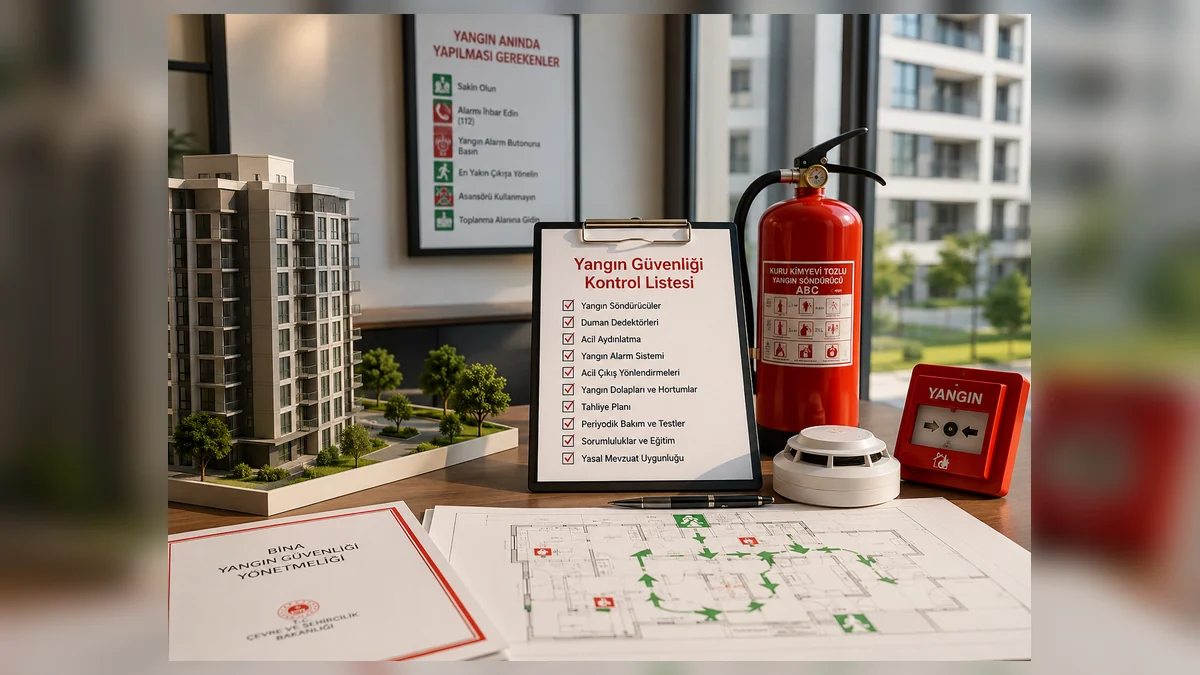
Before commitment, confirm that these items belong to the correct property, party and period: date and inspecting body, inspection scope, alarm and suppression systems, escape routes, fire-rated doors/compartmentation where applicable, deficiency list, remediation deadline and closure evidence. Keep any material unresolved point as a written condition before payment or signature.
A material open item that can change the outcome should remain a condition precedent to commitment, not a footnote.
Documents and data that must reconcile
For “Pre-Commitment Freeze”, the key evidence is: date and inspecting body, inspection scope, alarm and suppression systems, escape routes, fire-rated doors/compartmentation where applicable, deficiency list, remediation deadline and closure evidence
Scope boundary
Because this record is limited to “Pre-Commitment Freeze”, its boundary matters: Fire safety is not structural or earthquake assessment; evidence for those fields should remain separate.
What should be frozen before a binding commitment
A pre-commitment freeze is a dated evidence snapshot, not a promise that fire-safety conditions will never change. Before signing a reservation, preliminary agreement or other binding instrument, capture the exact fire-safety status relied upon in the decision: the latest inspection record, open deficiency list, remediation deadline, evidence of completed repairs, the current maintenance/test schedule and the identity of the party responsible for unresolved work. The 2026 statutory framework makes this especially important because periodic controls and remediation duties can create new findings after an older report was issued. The freeze date therefore needs to be explicit.
The frozen pack should distinguish existing legal or technical requirements from future work that is merely planned. A quotation for replacing a pump, detector, door or alarm component is not proof of completion. Likewise, a management resolution to obtain a new inspection is not equivalent to an inspection result. Where the transaction price, handover date or contractual allocation of cost depends on a deficiency being closed, the file should state the objective evidence that will count as closure and who bears the cost if closure is not achieved by the agreed date.
Do not freeze only favourable documents. Preserve notices, adverse findings, correspondence with the fire authority, contractor reports and any conflicting versions. Record the building identifier and address consistently so evidence from another block or phase cannot be mixed into the file. A useful freeze memo lists what was verified, what remained open, the source and date of each item, and which assumptions were deliberately excluded. That snapshot can later be compared with the closing-day recheck to identify changes rather than silently treating the earlier state as current.
Official source
Ministry of Environment — 2026 Building Fire-Safety Controls
Freezing the evidence before financial commitment
A pre-commitment freeze is designed to prevent the fire-safety file from silently changing between the buyer’s decision and a large deposit, binding signature or other difficult-to-reverse step. Before that point, preserve a dated copy of the latest available inspection, the deficiency list, any remediation deadline correspondence and evidence of completed work. The file should show what was actually known on the decision date, not merely what was added later after a problem surfaced.
A proper freeze does not mean ignoring later information. It creates a baseline and then records every subsequent event against it. A new inspection, expiry of a remediation period, change in building management, incident or corrective work should be logged as a post-freeze event and assessed before the next payment or signature. The reviewer must also distinguish who has authority to confirm closure. A contractor invoice or photograph may prove that work was attempted, but it does not necessarily prove that the competent inspection body accepted the deficiency as closed.
Where payments are staged, release conditions should be tied to defined evidence rather than a generic statement that the building is “fire safe”. Useful conditions include obtaining the latest official or primary inspection record, confirming that no expired corrective deadline remains unresolved, and reconciling any mismatch between the record and visible building conditions. The freeze therefore becomes a transaction-control tool: it preserves the evidential state relied upon by the buyer and makes later changes visible before money or legal commitment advances.