
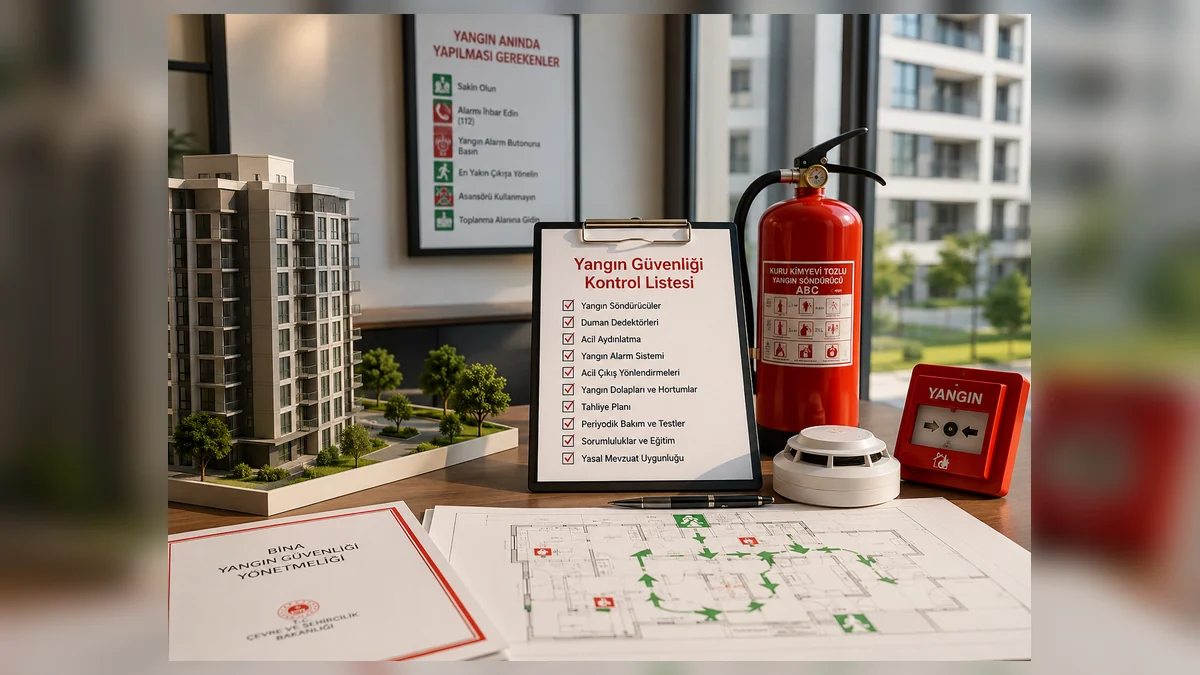
Official facts that control the topic
The first substantive rule for “Independent Evidence Replication — Fire safety records” is this: In May 2026 the Ministry of Environment announced a new framework for periodic building fire-safety inspections, with building owners or managers responsible for following the applicable requirements.
Applied specifically through the “Independent Evidence Replication” lens to Fire safety records, the official position is more precise: Inspections may be carried out by fire departments or authorised fire-safety experts under the framework and address the building’s required safety measures rather than merely the presence of an extinguisher or an old report. Where deficiencies are found, the announced framework can allow a remediation period of up to six months, making the deficiency list and evidence of correction as important as the inspection date.
What this review changes
Independent replication means a second person should be able to reach the same conclusion about Fire safety records from the primary evidence without relying on the first reviewer’s explanation. The test is evidence strength, not opinion repetition.
Re-extract these items directly from the primary source: date and inspecting body, inspection scope, alarm and suppression systems, escape routes, fire-rated doors/compartmentation where applicable, deficiency list, remediation deadline and closure evidence. Compare them with the file; a difference in an identifier, date or scope can reveal reliance on another version or a mistaken reading.
If the conclusion cannot be reproduced from the same official source, the fact should not be treated as stable until the reason is identified.
Documents and data that must reconcile
For “Independent Evidence Replication”, the key evidence is: date and inspecting body, inspection scope, alarm and suppression systems, escape routes, fire-rated doors/compartmentation where applicable, deficiency list, remediation deadline and closure evidence
Scope boundary
Because this record is limited to “Independent Evidence Replication”, its boundary matters: Fire safety is not structural or earthquake assessment; evidence for those fields should remain separate.
How to replicate the fire-safety conclusion independently
A second reviewer should be able to rebuild the conclusion without relying on the first reviewer’s notes. Start with the current inspection or official fire-safety record, identify the exact building or independent section covered, and record the issuing body, inspection date, scope, reference number and any stated deficiencies. Then obtain the maintenance and test evidence for the systems that matter to that building: detection and alarm, emergency lighting and signage, evacuation routes, smoke control where installed, fixed suppression systems, water supply and portable extinguishers. The Ministry’s fire-protection guide also treats periodic testing and maintenance as an ongoing responsibility of the owner, manager or authorised building representative; therefore a one-time certificate does not by itself prove that every system remains operational.
Replication is strongest when every material finding can be tied to a primary document. If the file says that a deficiency was corrected, look for the repair record, commissioning or test result, and—where required—evidence that the competent authority accepted or closed the issue. If the latest official record is newer than a seller’s or manager’s summary, the newer record controls the factual review. Distinguish three dates: the date a deficiency was observed, the date corrective work was performed, and the date the correction was verified. They are not interchangeable. An unresolved gap should remain an open item rather than being converted into an assumption.
The output of an independent replication should therefore be a short evidence matrix showing each safety item, the primary source used, its date, the reproduced finding and any discrepancy with the existing file. This makes the conclusion auditable and prevents a stale report, an informal statement or a maintenance invoice from being treated as equivalent to a current compliance finding.
Official source
Ministry of Environment — 2026 Building Fire-Safety Controls
How independent replication should be performed
An independent fire-safety review should not begin and end with the seller’s copy of an old inspection. First identify the exact building and the part of the property covered by the record, then verify the issuer, inspection date and scope against the authority or other primary source. The reviewer should distinguish between evidence that an inspection occurred and evidence that every recorded deficiency was actually closed. Alarm systems, suppression equipment, escape routes, fire doors or compartmentation where applicable, and any remediation list should be traced separately rather than collapsed into a single “passed” label.
The second reviewer must be able to reproduce the conclusion without relying on the first reviewer’s notes. That means recording where each document came from, when it was retrieved, which version was used and what exact fact it proves. If two reports conflict, the answer is not to choose the more reassuring one. Determine which is later, whether it comes from the competent body, whether the scope changed, and whether a later correction or closure record superseded an earlier deficiency. A structural or earthquake assessment must also remain separate because it answers a different safety question.
Replication becomes especially important where there has been recent maintenance, a change of use, a previous complaint, a long gap since the last check, or a transaction relying on a scanned document supplied by one party. The evidence file should therefore preserve the report identifier or date, inspecting body, scope, deficiency list, deadline, corrective evidence and the date on which that corrective evidence was verified. A defensible conclusion is not simply “the building is safe”; it is a traceable chain that another competent reviewer can follow and reach the same result.