
Official Source Revalidation — Fire safety records
What the official record proves
For “Official Source Revalidation — Fire safety records”, authenticity is established through the issuing authority and chain of acquisition, not by the appearance of a PDF or an institutional logo. If bank-account or payment instructions change by email or message, the change should be confirmed through an independent, previously verified channel before funds move; a genuine contract does not make later payment instructions automatically genuine. Official systems such as EİDS or Web Tapu prove only the elements within their scope and should not be used to legitimize unrelated data. For official-source revalidation, preserve old and new versions, receipt time, sender, verification channel and result; that audit trail is what later exposes silent substitution or forged versions.
Reconcile record and reality
For “Official Source Revalidation — Fire safety records”, the land-registry record must be separated from marketing descriptions. TKGM lists party identification and, where representation is used, the representation document among sale-transaction materials; the registered owner, independent-unit details and recorded restrictions remain the controlling evidence when descriptions conflict. Names, identity or passport data and property identifiers should therefore be reconciled before signature, and the registry output relied upon should be preserved with its retrieval date. This is especially material to official-source revalidation, because an unexplained identity or asset mismatch can change whether the transaction can proceed at all.
Limits of the evidence
For “Official Source Revalidation — Fire safety records”, the Energy Performance Certificate and fire-safety records should be treated as documents with defined scopes, not as general guarantees of building quality. Ministry guidance states that the EKB contains information on energy need/consumption, insulation and heating/cooling efficiency and is valid for ten years from issuance; it also interacts with new-building occupancy procedures. Fire-prevention reporting requirements depend on building type and use and can require permit/occupancy and municipal documentation. For official-source revalidation, the actual certificate/report, building identifier, issue date, issuer and any later change of use are checked before drawing a conclusion.
Decision consequence
For “Official Source Revalidation — Fire safety records”, the legal form of a document must be identified rather than assuming every private contract or notarized paper has the same effect. The Notary Law also allows notaries to execute real-estate sale contracts within the statutory system, while registry, identity and representation data remain decisive. Where a power of attorney is used, the authority relevant to sale, purchase, price handling, mortgage or the particular act is checked; broad wording should not be treated automatically as unlimited authority. For official-source revalidation, versions, certifications, translations and attachments are preserved in sequence, and any change to a page, amount or party triggers re-verification before reliance.
Primary and official sources
- Ministry of Environment — 2026 Building Fire-Safety Controls — https://meslekihizmetler.csb.gov.tr/haberler/binalarda-yangin-guvenliginde-yeni-donem-305321
- TKGM — sale transaction documents / Web Tapu — https://www.tkgm.gov.tr/sss
- Ministry of Justice — Notary Law — https://mevzuat.adalet.gov.tr/mevzuat/103477
Evidence and decision plan for Official Source Revalidation — Fire safety records
When reviewing “Official Source Revalidation — Fire safety records”, the file should return to the competent official source and verify that the prior conclusion still matches the current rule or record. This makes the article useful at the point of commitment because unresolved facts are separated from verified facts instead of being buried in narrative.
Evidence to assemble
- For “Official Source Revalidation — Fire safety records”, match the property and party identifiers in the evidence to the asset and people actually involved; a correct document for the wrong unit or person does not close the check.
- For “Official Source Revalidation — Fire safety records”, record issuer, source, issue or retrieval date and version where available, then distinguish an original/current record from a scan, translation, draft, expired copy or superseded version.
- For “Official Source Revalidation — Fire safety records”, compare documentary status with the physical, payment or operational reality relevant to the topic and write down every unexplained difference before commitment.
- For “Official Source Revalidation — Fire safety records”, convert each unresolved difference into a named condition: evidence required, person responsible, deadline and the consequence if the condition is not satisfied.
Official reference to recheck
The source register for “Official Source Revalidation — Fire safety records” includes Ministry of Environment — 2026 Building Fire-Safety Controls (https://meslekihizmetler.csb.gov.tr/haberler/binalarda-yangin-guvenliginde-yeni-donem-305321). Use that source for the matters within its authority and recheck it when timing or rules are material; it does not replace a registry, engineering, tax, banking or contractual record that the specific decision separately requires.
Decision boundary
A defensible conclusion on “Official Source Revalidation — Fire safety records” records both what was verified and the limits of that verification. If a missing fact could change ownership, legality, safety, cost or payment security, it should block the related commitment until resolved.
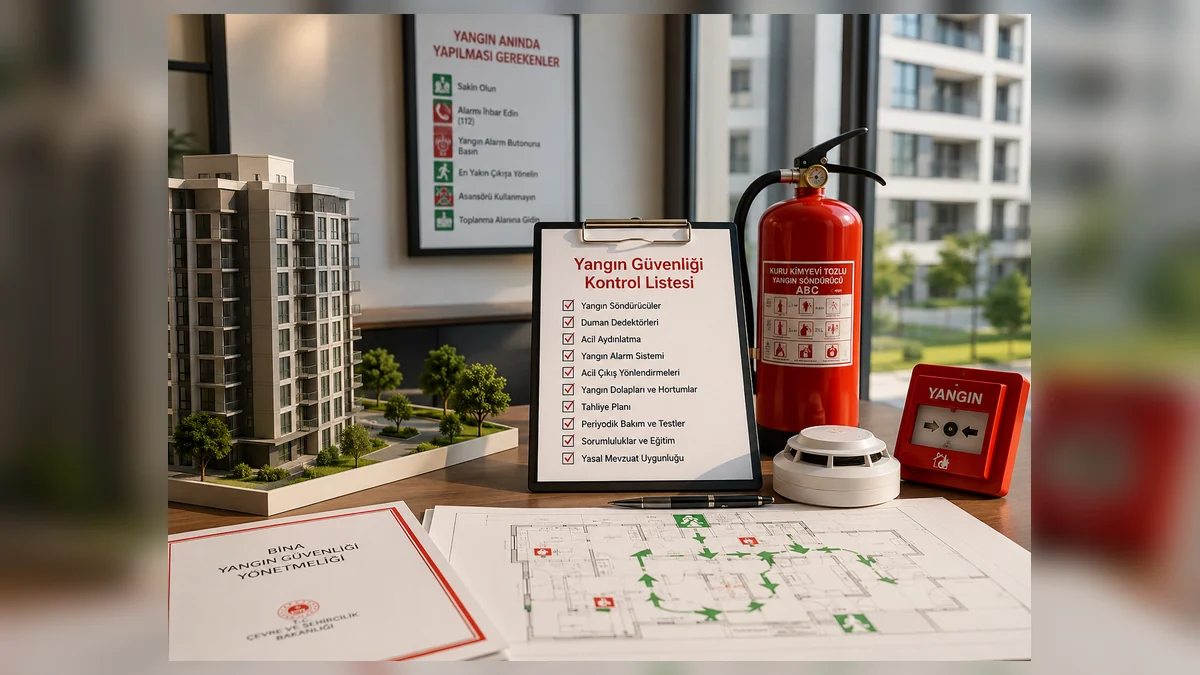
Revalidating fire-safety records after the 2026 changes
Fire-safety records are particularly sensitive to regulatory change. In May 2026, the Ministry of Environment, Urbanisation and Climate Change announced a new framework for mandatory periodic fire-safety controls, involving the relevant fire service or authorised fire-safety experts depending on the case and allowing defined periods for curing deficiencies. An older report or prior approval should therefore not be assumed sufficient where the current inspection regime applies to the building.
Recheck building type, latest inspection or report, open findings and any correction deadline. Separate the visual presence of extinguishers or alarms from evidence that the required system-level control was completed and that recorded deficiencies were actually closed.
Additional questions and context
What cost can arise from a problem in building fire-safety records?
Use the Ministry’s current fire-safety guide and latest regulatory/control updates because requirements and control mechanisms can evolve. Use the Ministry’s current fire-safety guide and latest regulatory/control updates because requirements and control mechanisms can evolve. Confirm applicability to the building’s use, height and configuration rather than copying generic thresholds. Official source: Ministry of Environment