
Core risk review: can the sale-tax file be recalculated and proved?
A property-sale tax risk review should not begin with the question “how much tax is due?”. It begins by determining whether the disposal is within the capital-gain regime and whether the calculation can be reconstructed from records that belong to the same property, seller and tax year. Current GİB guidance states that real estate acquired for consideration and disposed of within five years may generate taxable capital appreciation, while inherited or otherwise gratuitously acquired real estate is outside that rule merely because it is sold within five years. A wrong acquisition classification can therefore invalidate the entire analysis even when the arithmetic looks correct.
1. Acquisition-date risk
Establish the acquisition date from the relevant evidence and do not approximate the five-year period by counting calendar years. Where contract, physical delivery and title registration dates differ, keep the issue open until the applicable evidence supports the date used in the tax analysis.
2. Consideration versus gratuitous acquisition
Inheritance and other gratuitous acquisitions are not simply purchases with a zero cost. They have a different treatment under the capital-gain rule. Do not invent a purchase price and create a hypothetical taxable gain from it.
3. Unsupported acquisition cost
The purchase file should connect the acquisition amount to documentary evidence and to any legally deductible seller-borne disposal expenses, taxes or fees used in the net-gain calculation. An internal spreadsheet is useful as a working paper but is not a substitute for the underlying evidence.
4. Yİ-ÜFE indexation risk
Indexation is not automatic. GİB states that the acquisition cost is indexed when the relevant Yİ-ÜFE increase is at least 10%; below that level the acquisition cost is not indexed. Preserve the two relevant index periods, values, formula and result so another reviewer can reproduce the computation.
5. Wrong annual exemption
The exemption is year-specific. GİB lists TRY 120,000 for 2025 gains and TRY 150,000 for 2026 gains. A sale occurring in 2025 does not use the 2026 exemption merely because the declaration is filed in 2026. The income year controls the exemption.
6. Mixing income tax with title-deed fees
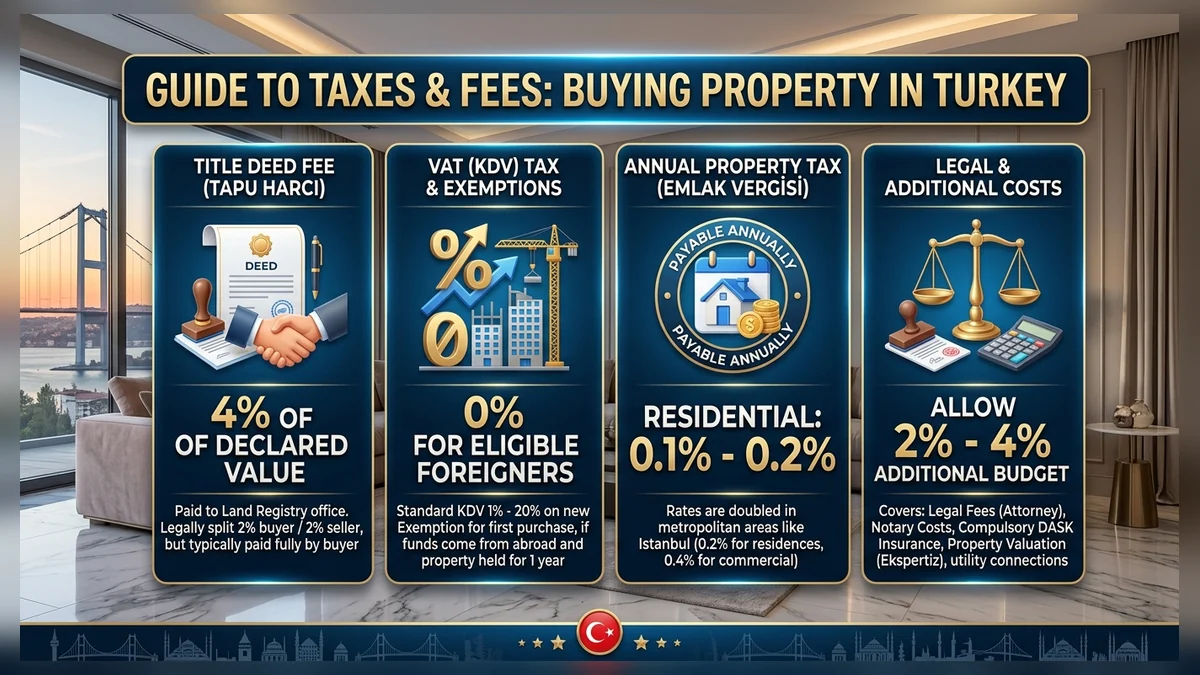
Capital-gain income tax and Tapu Harcı are separate obligations with different legal bases, calculations and evidence. The seller tax file should remain distinct from the title-transfer fee file and from any private closing adjustment between buyer and seller.
7. Filing and payment evidence
If the review concludes that declarable income exists, retain the relevant return, payment evidence and any correction or assessment that follows. A cropped screenshot, receipt for a different year, or document that does not identify the taxpayer cannot close the issue.
Risk outcome
- Low: acquisition method/date are proved, the five-year test is resolved, and the calculation is reproducible.
- Medium: the tax position is broadly clear but one cost, indexation, exemption or payment document remains incomplete.
- High: acquisition date is disputed, acquisition type is misclassified, the wrong annual rule is used, or material figures have no evidence.
Do not close the review with a generic statement such as “tax paid”. Close it with the document, date, formula, income year, official reference and result.
Property sale tax records Risk Review
Core question
Treat this as a transaction decision file. For “Property sale tax records Risk Review”, begin with sale and risk and make sure both relate to the same asset, party and review date.
Practical cure
Required evidence
Build the evidence set around sale, risk, official, source, date and identity. Mark each as verified, conflicting, stale or unavailable.
- date
- evidence
- authority
- risk
- identity
- source
Failure scenario
Failure example: sale looks correct, but date belongs to a different date, unit or transaction. Keep the issue open and record whether it affects price, payment, use, finance, possession or registration.
- authority
- sale
- evidence
- official
- source
- date
Decision rule
Independent check
Check official independently from the person or document that supplied sale. If it conflicts with source, identify the authoritative owner of the fact and obtain a fresh record.
Audit trail
Record-specific evidence matrix
| Item | Cross-check | Status |
|---|---|---|
| identity | source | Open / Verified |
| risk | official | Open / Verified |
| sale | date | Open / Verified |
Official sources
Practical questions answered from primary sources
Can 2026 exemption amount change whether a property-sale capital-gain tax transaction can proceed?
GİB’s current guidance says that real estate acquired for consideration and sold within five years can generate taxable capital gain; inherited or gratuitously acquired property is outside this capital-gain rule. The exemption for 2026 gains is TRY 150,000, and acquisition cost is indexed only where the relevant Yİ-ÜFE increase is at least 10%. A property sale can create income-tax exposure on capital appreciation depending on acquisition method/date and statutory exceptions. Do not confuse this with title-deed fees; they are separate obligations with different bases and records. A major risk is treating historically correct information as currently valid; verify the year and period covered by every document. For this exact point—“2026 exemption amount” within property-sale capital-gain tax—use the cited source to establish the governing rule for the same property and current transaction.
Which document gives the current answer on 2026 exemption amount in property-sale capital-gain tax, specifically 2026 exemption amount?
A major risk is treating historically correct information as currently valid; verify the year and period covered by every document. GİB explains that disposal of certain properties within five years of acquisition can fall under capital-gain rules and lists the 2026 exemption amount as TRY 150,000. This is annual and must be rechecked for the sale year. For the document check on “2026 exemption amount” within property-sale capital-gain tax, match the official identifiers, date, authority and scope to the closing file; a related document for another unit or older version is not enough.
What should be rechecked immediately before payment in property-sale capital-gain tax, specifically 2026 exemption amount?
GİB explains that disposal of certain properties within five years of acquisition can fall under capital-gain rules and lists the 2026 exemption amount as TRY 150,000. This is annual and must be rechecked for the sale year. Collect acquisition document/date, cost and supported expenses, sale amount and indexation inputs where applicable, then use the official GİB guide/calculator rather than a broker estimate. For the risk question on “2026 exemption amount” within property-sale capital-gain tax, treat any unresolved mismatch as a live transaction issue until the competent record or authority shows the required status.
Sources checked: 16 August 2026.
- GİB — Diğer Kazanç ve İratlar
- GİB — 2026 Değer Artışı Kazancı Rehberi
- GİB — Gayrimenkullerin 5 Yıl İçinde Elden Çıkarılması
Risk review
A major risk is treating historically correct information as currently valid; verify the year and period covered by every document.
Evidence and decision plan for Property sale tax records Risk Review
For “Property sale tax records Risk Review”, the practical objective is to identify the material ways the topic can fail, then connect each risk to evidence and a transaction consequence. The review should distinguish what is proved now, what still depends on a missing or stale document, and what difference that gap makes to price, signing, payment, handover or later resale.
Evidence to assemble
- For “Property sale tax records Risk Review”, match the property and party identifiers in the evidence to the asset and people actually involved; a correct document for the wrong unit or person does not close the check.
- For “Property sale tax records Risk Review”, record issuer, source, issue or retrieval date and version where available, then distinguish an original/current record from a scan, translation, draft, expired copy or superseded version.
- For “Property sale tax records Risk Review”, compare documentary status with the physical, payment or operational reality relevant to the topic and write down every unexplained difference before commitment.
- For “Property sale tax records Risk Review”, convert each unresolved difference into a named condition: evidence required, person responsible, deadline and the consequence if the condition is not satisfied.
Official reference to recheck
The source register for “Property sale tax records Risk Review” includes TKGM — Tapu ve Kadastro Genel Müdürlüğü (https://www.tkgm.gov.tr/anasayfa). Use that source for the matters within its authority and recheck it when timing or rules are material; it does not replace a registry, engineering, tax, banking or contractual record that the specific decision separately requires.
Decision boundary
Close “Property sale tax records Risk Review” only when the conclusion can be reproduced from evidence by another reviewer. A reasonable outcome may be proceed, proceed subject to a written condition, reprice, obtain specialist advice, or stop; uncertainty should remain visible instead of being converted into a positive statement.