
Warning signs that justify holding or escalating the tax file
A red flag is more than a document that can be requested later. It indicates that classification, computation or proof may be materially wrong. Use these signals to decide when a property-sale capital-gain file should be held or escalated before acceptance.
1. Five years counted by calendar labels
A statement such as “bought in 2021, sold in 2026, therefore five years” without exact dates is a warning. The relevant period must be tested from the supported acquisition date to the disposal date.
2. Inheritance treated as a zero-cost purchase
If inherited or gratuitously acquired property is forced into an ordinary purchase worksheet with zero cost, stop the classification. Current GİB guidance treats gratuitous acquisition differently within the capital-gain rules.
3. Yİ-ÜFE applied without the 10% test
Any worksheet that automatically indexes acquisition cost without showing the relevant percentage increase is unsafe. Current guidance requires the relevant increase to be at least 10% for indexation.
4. 2026 exemption used for a 2025 sale
This is a clear year mismatch. GİB lists TRY 120,000 for 2025 capital gains and TRY 150,000 for 2026. Filing year cannot replace the income year.
5. Acquisition cost without underlying evidence
A large number in a spreadsheet is not sufficient if no contract, receipt or other evidence links it to acquisition. The same applies to disposal expenses, taxes and fees deducted in the calculation.
6. Sale proceeds do not reconcile with the transaction file
If contract, title-transfer, bank-transfer or settlement figures differ and no reconciliation explains them, hold the calculation until the discrepancy is understood.
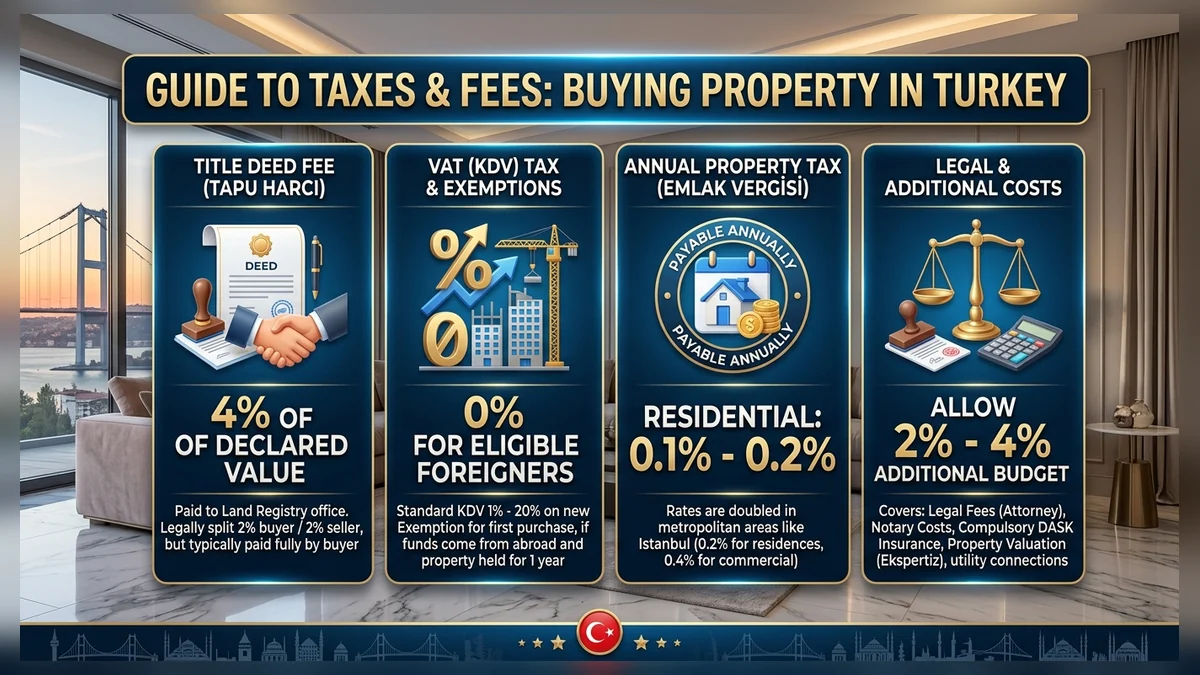
7. Tapu Harcı mixed with capital-gain income tax
If title-transfer fees and seller income tax are combined into one “sale tax” line, there is a risk of wrong allocation or duplicate treatment. Keep separate legal and accounting tracks.
8. “Tax paid” with no matching return or official reference
An undated receipt, cropped screenshot or payment that does not identify the correct taxpayer and income year does not prove that the relevant obligation was settled. Reconcile return, payment and reference.
9. Old calculation deleted after a change
Replacing a worksheet without retaining the earlier version and change reason breaks the audit trail, especially when cost, date or tax treatment changed.
10. Annual figures sourced only from an agent or blog
Exemptions, filing dates and procedures change. If the only support is an article or message, recheck GİB before finalising the file.
11. Pressure to close before a material fact is resolved
“Pay now and fix tax later” does not resolve a disputed acquisition date, acquisition method or sale amount. A fact capable of changing tax scope or amount must remain visible and be escalated where necessary.
Response to a flag
- Correct: minor clerical or linking error that does not change the conclusion.
- Hold: missing or conflicting evidence can change the computation.
- Escalate: acquisition method/date, activity classification or tax rule cannot be resolved from the file.
- Stop: suspected forged evidence, knowingly false figures or unverifiable payment instructions.
Property sale tax records Red Flags Guide
Core question
Record uncertainty explicitly instead of assuming clean status. For “Property sale tax records Red Flags Guide”, begin with sale and flags and make sure both relate to the same asset, party and review date.
Independent check
Decision rule
Failure scenario
- authority
- date
- evidence
- flags
- sale
- identity
Practical cure
Required evidence
Build the evidence set around sale, flags, official, source, date and identity. Mark each as verified, conflicting, stale or unavailable.
- official
- date
- evidence
- authority
- sale
- source
Audit trail
Record-specific evidence matrix
| Item | Cross-check | Status |
|---|---|---|
| sale | flags | Open / Verified |
| identity | source | Open / Verified |
| evidence | official | Open / Verified |
Official sources
Practical questions answered from primary sources
How do you compare two documents that disagree on declaration and payment timing in property-sale capital-gain tax, specifically declaration and payment timing?
GİB’s current guidance says that real estate acquired for consideration and sold within five years can generate taxable capital gain; inherited or gratuitously acquired property is outside this capital-gain rule. The exemption for 2026 gains is TRY 150,000, and acquisition cost is indexed only where the relevant Yİ-ÜFE increase is at least 10%. A property sale can create income-tax exposure on capital appreciation depending on acquisition method/date and statutory exceptions. Do not confuse this with title-deed fees; they are separate obligations with different bases and records. Red flags include unsourced figures, undated records, identity/address/unit mismatches, or payment instructions inconsistent with the official channel. For this exact point—“declaration and payment timing” within property-sale capital-gain tax—use the cited source to establish the governing rule for the same property and current transaction.
Which document version should control the transaction in property-sale capital-gain tax, specifically declaration and payment timing?
Red flags include unsourced figures, undated records, identity/address/unit mismatches, or payment instructions inconsistent with the official channel. GİB explains that disposal of certain properties within five years of acquisition can fall under capital-gain rules and lists the 2026 exemption amount as TRY 150,000. This is annual and must be rechecked for the sale year. For the document check on “declaration and payment timing” within property-sale capital-gain tax, match the official identifiers, date, authority and scope to the closing file; a related document for another unit or older version is not enough.
Why does the date of the record matter for declaration and payment timing in property-sale capital-gain tax, specifically declaration and payment timing?
GİB explains that disposal of certain properties within five years of acquisition can fall under capital-gain rules and lists the 2026 exemption amount as TRY 150,000. This is annual and must be rechecked for the sale year. Collect acquisition document/date, cost and supported expenses, sale amount and indexation inputs where applicable, then use the official GİB guide/calculator rather than a broker estimate. For the risk question on “declaration and payment timing” within property-sale capital-gain tax, treat any unresolved mismatch as a live transaction issue until the competent record or authority shows the required status.
Sources checked: 16 August 2026.
- GİB — Diğer Kazanç ve İratlar
- GİB — 2026 Değer Artışı Kazancı Rehberi
- GİB — Gayrimenkullerin 5 Yıl İçinde Elden Çıkarılması
Red flags
Red flags include unsourced figures, undated records, identity/address/unit mismatches, or payment instructions inconsistent with the official channel.
Evidence and decision plan for Property sale tax records Red Flags Guide
The due-diligence purpose of “Property sale tax records Red Flags Guide” is to separate genuine warning signs from harmless irregularities and define which warning requires escalation before commitment. A reviewer should be able to trace every material conclusion to a current source and identify any assumption that has not yet become evidence.
Evidence to assemble
- For “Property sale tax records Red Flags Guide”, match the property and party identifiers in the evidence to the asset and people actually involved; a correct document for the wrong unit or person does not close the check.
- For “Property sale tax records Red Flags Guide”, record issuer, source, issue or retrieval date and version where available, then distinguish an original/current record from a scan, translation, draft, expired copy or superseded version.
- For “Property sale tax records Red Flags Guide”, compare documentary status with the physical, payment or operational reality relevant to the topic and write down every unexplained difference before commitment.
- For “Property sale tax records Red Flags Guide”, convert each unresolved difference into a named condition: evidence required, person responsible, deadline and the consequence if the condition is not satisfied.
Official reference to recheck
The source register for “Property sale tax records Red Flags Guide” includes TKGM — Tapu ve Kadastro Genel Müdürlüğü (https://www.tkgm.gov.tr/anasayfa). Use that source for the matters within its authority and recheck it when timing or rules are material; it does not replace a registry, engineering, tax, banking or contractual record that the specific decision separately requires.
Decision boundary
For “Property sale tax records Red Flags Guide”, a residual issue should remain open whenever its legal, technical, tax, payment or cost consequence cannot yet be measured. The file is ready only when that issue is closed or consciously accepted by the appropriate decision-maker.