
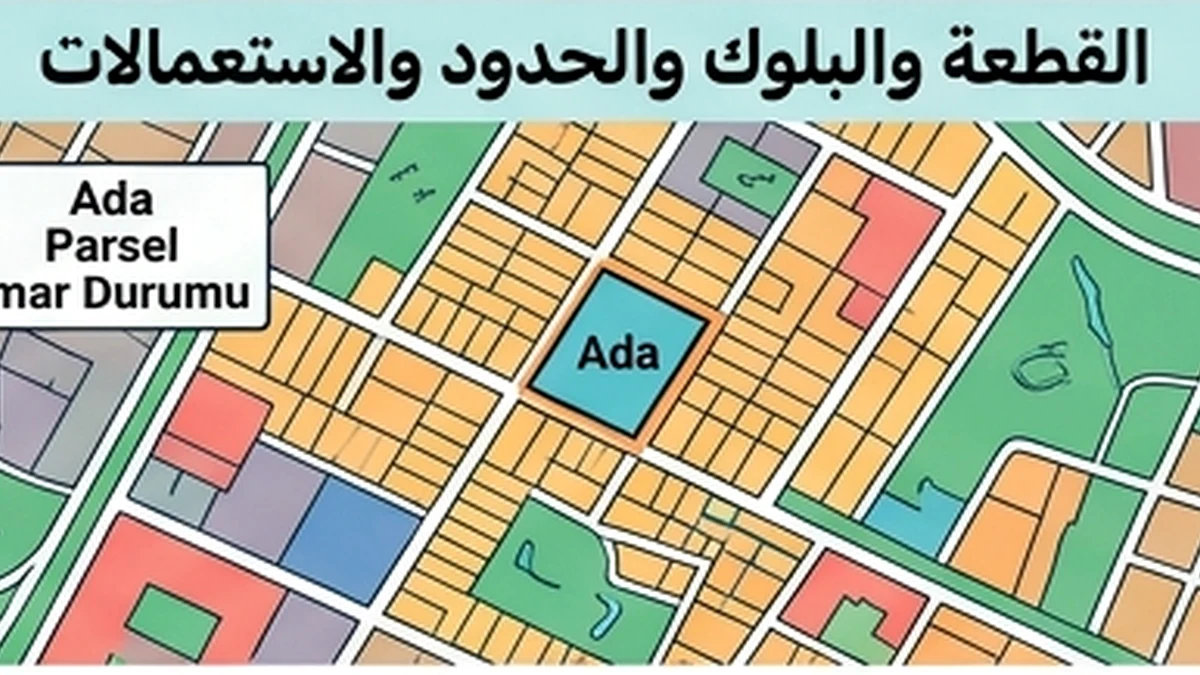
Parcel and block records Verification Guide
Start from the property location, identify the parcel in TKGM Parcel Query, and record province, district, neighborhood, block (ada) and parcel numbers. Do not stop at the public map: reconcile those identifiers with a current land-registry record or official Web Tapu document. TKGM documentation shows parcel searches using address and block/parcel fields, while Web Tapu provides current registry-document access.
Evidence and decision plan for Parcel and block records Verification Guide
When reviewing “Parcel and block records Verification Guide”, the file should verify the claimed fact from the strongest available primary evidence before relying on it. This makes the article useful at the point of commitment because unresolved facts are separated from verified facts instead of being buried in narrative.
Evidence to assemble
- For “Parcel and block records Verification Guide”, match the property and party identifiers in the evidence to the asset and people actually involved; a correct document for the wrong unit or person does not close the check.
- For “Parcel and block records Verification Guide”, record issuer, source, issue or retrieval date and version where available, then distinguish an original/current record from a scan, translation, draft, expired copy or superseded version.
- For “Parcel and block records Verification Guide”, compare documentary status with the physical, payment or operational reality relevant to the topic and write down every unexplained difference before commitment.
- For “Parcel and block records Verification Guide”, convert each unresolved difference into a named condition: evidence required, person responsible, deadline and the consequence if the condition is not satisfied.
Official reference to recheck
The source register for “Parcel and block records Verification Guide” includes TKGM — Parcel Query User Guide (https://parselsorgu.tkgm.gov.tr/app/documents/parsel-sorgu-kullanim-kilavuzu-v.1.2.pdf). Use that source for the matters within its authority and recheck it when timing or rules are material; it does not replace a registry, engineering, tax, banking or contractual record that the specific decision separately requires.
Decision boundary
A defensible conclusion on “Parcel and block records Verification Guide” records both what was verified and the limits of that verification. If a missing fact could change ownership, legality, safety, cost or payment security, it should block the related commitment until resolved.
Second-pass review for Parcel and block records Verification Guide
A second-pass review of “Parcel and block records Verification Guide” should test whether the first conclusion would survive a change of reviewer. Start from the underlying source rather than the previous summary, repeat the identity match, and check whether a later document, payment, amendment or physical change has altered the answer. The source register describes its relevance as: Official/primary source retained after strict archive cleaning; revalidate time-sensitive facts before a live transaction.
For “Parcel and block records Verification Guide”, keep a short discrepancy log that states the fact in question, the two conflicting pieces of evidence, the competent source chosen to resolve the conflict, and the transaction step held back while the discrepancy remains open.
At handover or file closure, “Parcel and block records Verification Guide” should leave a compact evidence package: the controlling document or source extract, supporting correspondence or technical evidence, the dated conclusion, and any condition the buyer accepted. This improves resale and future auditability without pretending that old evidence stays current forever.
Closure package for Parcel and block records Verification Guide
Before treating “Parcel and block records Verification Guide” as complete, verify that the evidence package answers four separate questions: what exactly was checked, which source had authority for that fact, when the source was checked, and what decision followed. Keeping those four elements together prevents a later reader from mistaking a recommendation for proof.
If “Parcel and block records Verification Guide” depends on more than one discipline, keep the boundaries explicit. A land-registry result should not be used as an engineering opinion, an insurance policy should not be used as a structural certificate, a tax value should not automatically become market value, and a marketing representation should not replace an official or contractual record.
Practical closure test for Parcel and block records Verification Guide
Before relying on “Parcel and block records Verification Guide”, make the file answer the topic-specific objective in operational terms: verify the claimed fact from the strongest available primary evidence before relying on it. The evidence should identify the exact asset or transaction, show when the fact was checked, and distinguish a current verified fact from an assumption carried forward from an earlier stage.
For “Parcel and block records Verification Guide”, use TKGM — Parcel Query User Guide (https://parselsorgu.tkgm.gov.tr/app/documents/parsel-sorgu-kullanim-kilavuzu-v.1.2.pdf) as one of the reference points already attached to the record. Confirm the scope of that source and keep any complementary registry, contract, engineering, tax, insurance or payment evidence separate so that one document is not asked to prove a fact outside its function.
A useful closure note for “Parcel and block records Verification Guide” should state what changed during the review, what remained unchanged, which discrepancy was resolved, and which residual issue—if any—was consciously accepted. If later resale, financing or dispute review would require the same evidence, preserve the controlling version and its retrieval date rather than only a narrative conclusion.
Additional questions and context
What should a buyer compare before relying on parcel and block (Ada/Parsel) verification?
Start from the property location, identify the parcel in TKGM Parcel Query, and record province, district, neighborhood, block (ada) and parcel numbers. Start from the property location, identify the parcel in TKGM Parcel Query, and record province, district, neighborhood, block (ada) and parcel numbers. Do not stop at the public map: reconcile those identifiers with a current land-registry record or official Web Tapu document. TKGM documentation shows parcel searches using address and block/parcel fields, while Web Tapu provides current registry-document access.