
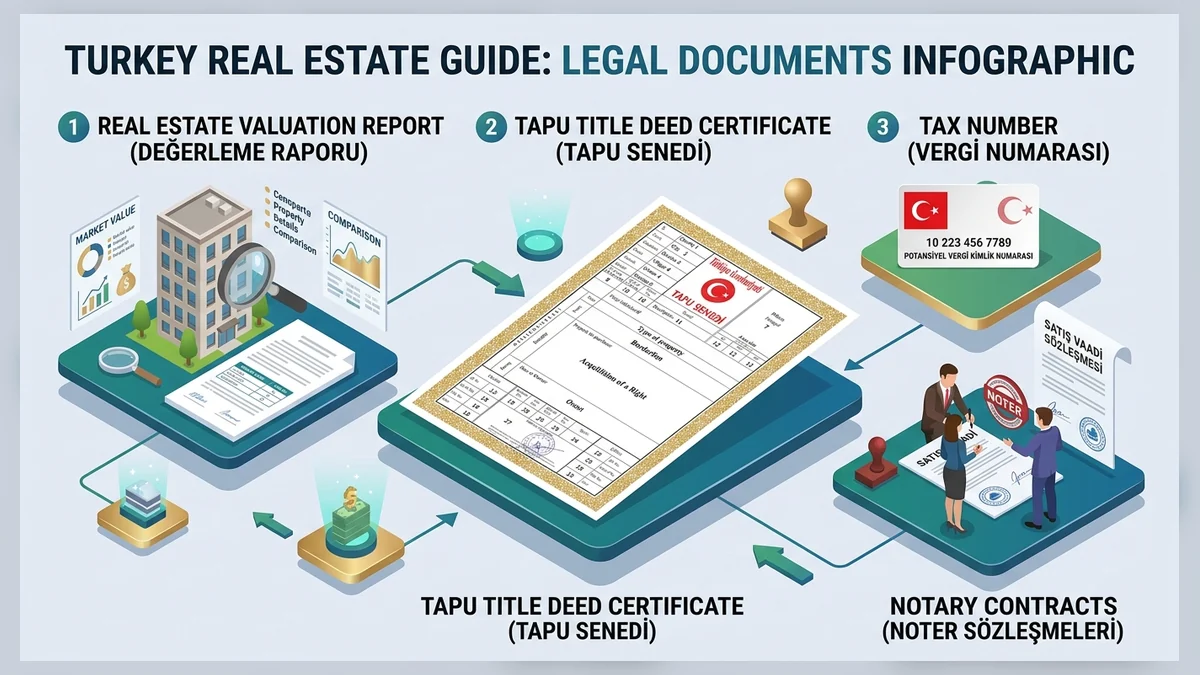
Property-owner document archive: organised records protect the owner during sale, tenancy and claims
Property documents accumulate for years: title records, contracts, DASK, additional insurance, maintenance invoices, management minutes, handover photos, utility agreements, leases, receipts and tax records. When they are scattered across email, messaging apps and a drawer, finding the right evidence during a sale, dispute or insurance claim becomes difficult. A good archive does not require complicated software. It requires a stable structure, clear file names, backups and control over who can access sensitive information.
Give each property a master identity
Create a folder with a clear property code and a reference sheet containing the address, ada/parsel, independent-unit number, purchase date, building-management contact, meter references and utility providers. Do not place passwords or unnecessarily sensitive banking data on the same sheet. The purpose is to allow the owner or successor to identify the property and find related files quickly.
Organise by function
Useful sections include ownership/title, purchase and sale, building/project, management and aidat, insurance, tax, utilities, maintenance and warranty, tenancy, inspections/photos and important correspondence. This is often more useful than organising everything only by year because a future insurance claim may require several years of policies and repairs together.
Preserve official files in their received form
If an official document arrives as a signed PDF or a verifiable digital file, retain that original rather than replacing it with a screenshot. Where a legally important paper original exists, scan it but keep the original if it may later be required. A digital copy is convenient; it should not be used as a reason to destroy a document whose original format may matter.
Use sortable file names
A simple naming convention such as YYYY-MM-DD_Document-Type_Issuer_Property makes search and chronology easy. Avoid names such as IMG1234 or final-final-new. When a document is renewed, keep the previous dated version rather than overwriting it. Historical versions can prove what policy, contract or condition applied at a particular time.
Keep a decision trail for material work
For major repairs, preserve more than the final invoice. Keep the problem description, quotations, approval, before/after photographs and warranty. In a tenant or management dispute, a clear timeline is stronger than disconnected messages. A short note stating the issue, decision, approver and cost can make later review much easier.
Separate permanent and renewable records
Title records, core approved plans and acquisition POAs may remain relevant for many years. DASK, additional insurance and service contracts renew. Create expiry reminders for renewable documents. Do not delete the expired version immediately after renewal; it may be needed to prove that cover or contractual service existed on a past date.
Maintain independent backups
Do not rely on one phone or laptop. Use reputable cloud storage with strong account protection and an independent second copy. For particularly important files, consider encrypted storage or an offline backup in another location. Test restoration periodically. A backup that has never been checked may fail when it is finally needed.
Control access to personal information
Property files can contain passports, tax numbers, signatures and bank data. Do not share an entire archive with a broker who needs one document. Use limited links or redacted copies where appropriate. A property manager may need operational records but not the owner’s complete banking or identity history. Least-necessary access reduces misuse risk.
Keep structured tenancy and maintenance records
For each tenant, retain the lease, deposit evidence, move-in record, condition photographs, meter readings, repair requests, material notices and final handover. For important equipment, keep purchase invoices, warranty and service history. This helps with replacement decisions and prevents an owner paying for repairs that remain covered by warranty.
Maintain a sale-ready pack
When an owner decides to sell, reconstructing years of documents under time pressure is expensive. Keep an updated sale pack containing current title information, relevant building status, aidat information, insurance, invoices for significant work, key/appliance inventory and any current lease. Do not give every archived file to a buyer; disclose what is appropriate for the diligence stage.
Review the archive annually
Once a year remove unnecessary duplicates, standardise names, confirm backups and add missing records. Do not destroy documents that may be subject to legal or tax retention requirements without first checking the appropriate period. A disciplined archive reduces the cost of selling, claims and disputes and turns the property’s history into an understandable record rather than fragments spread across devices and accounts.